How Much Is 100 Grams? 15 Most Common Things That Weigh About 100 Grams
How much is 100 grams is a question about weight. It equals one-tenth of a kilogram. People use it to measure food, small objects, and ingredients in cooking.
Have you ever tried to imagine 100 grams without a scale? It can be tricky. Visual examples make it easier to understand.
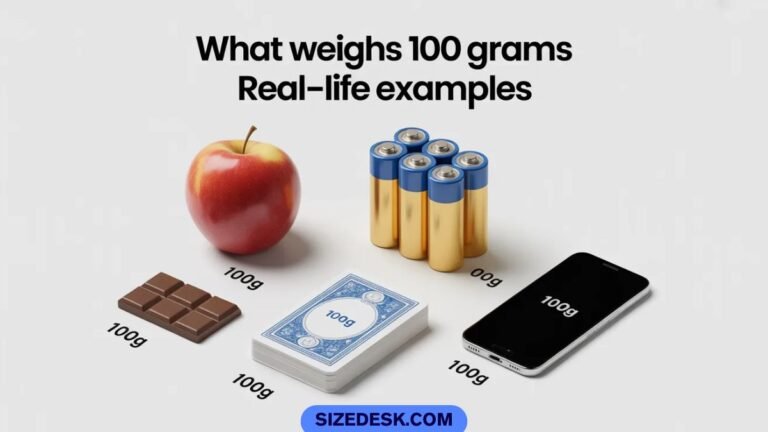
100 grams can be a medium apple, two eggs, or a small bar of soap. Knowing this weight helps in cooking, shopping, and daily life.
What Is 100 Grams In Weight?
100 grams in weight is a metric measurement, equal to 0.1 kilograms. In US customary units, it’s roughly 3.53 ounces or 0.22 pounds. Many people ask, “how heavy is 100 grams?” To put it simply, it’s about the weight of a medium apple, half a cup of sugar, or a small bar of soap. You can also see it as a little less than a quarter of a pound.
Here’s a quick 100 grams comparison chart to help you visualize it:
| Unit | Equivalent of 100 grams |
| Kilograms | 0.1 kg |
| Milligrams | 100,000 mg |
| Ounces | 3.53 oz |
| Pounds | 0.22 lbs |
| Cups (US flour) | ~¾ cup |
| Tablespoons (US) | ~6.7 tbsp |
| Teaspoons (US) | ~20 tsp |
| Milliliters (water) | 100 mL |
Knowing how to measure 100 grams is easier when you see these conversions. For example, 100 grams to cups or 100 grams in kg helps when scaling recipes or tracking portions. If you don’t have a scale, visualizing examples of 100 gram items can be a real lifesaver.
How Much Is 100 Grams?
People often struggle to estimate what 100 grams looks like. Imagine holding a medium-sized banana or two tennis balls in your hand that’s roughly 100 grams. In cooking, 100 grams of sugar or flour can make a big difference in texture and taste. In fitness, 100 grams of chicken breast gives about 31 grams of protein, which is handy for meal planning.
A practical tip is to compare 100 grams weight in everyday life with objects you see often. Think about a computer mouse, a small candle, or a small bunch of grapes. Visualizing 100 grams of food examples or common objects weighing 100 grams helps you estimate 100 grams without a scale.
Most Common Things That Weigh About 100 Grams
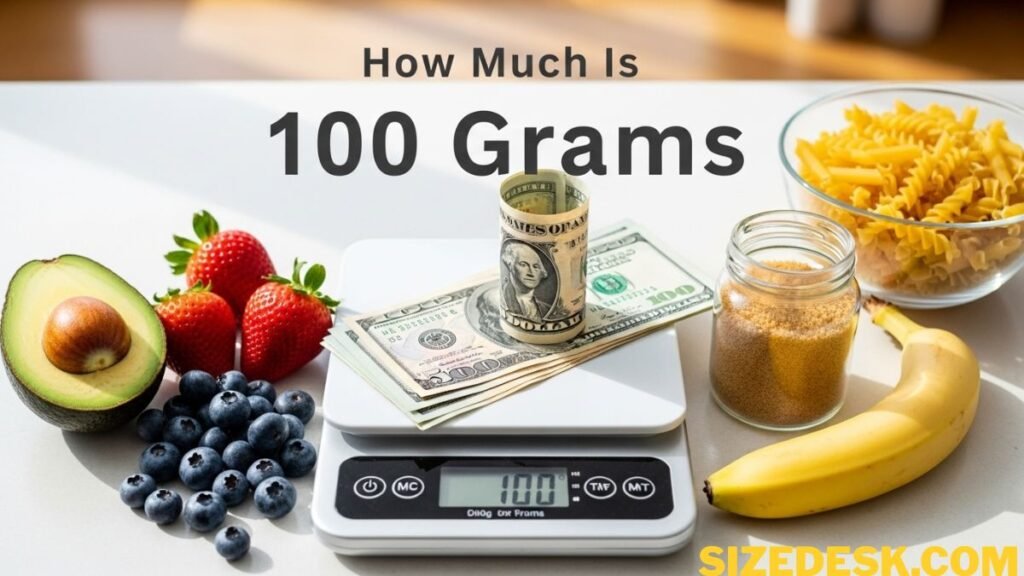
It’s easier to understand items around 100 grams when you have real-world comparisons. Here’s a list of everyday things equal to 100 grams, with approximate weight and visual cues to help you see what 100 grams looks like.
A Medium-Sized Apple
A medium apple weighs roughly 100–200 grams, which is perfect for a snack or lunchbox. Apples are full of fiber, vitamin C, and antioxidants that support heart and digestive health. By looking at a medium apple, you can easily visualize 100 grams. A simple tip is that the size is about 2.5 to 3 inches in diameter, and it fits nicely in your palm.
A Standard Bar Of Soap
A bar of soap usually weighs around 100–150 grams. Its rectangular shape makes it a good reference for common household items weighing 100 grams. Beyond cleaning, knowing its weight helps you estimate 100 grams in everyday objects. Regular handwashing with soap also prevents the spread of germs, which makes it both practical and health-conscious.
A Small Candle
Small candles range from 50–150 grams depending on size. When you hold one in your hand, you’re experiencing 100g weight in common things. Candles provide relaxation, ambiance, or decoration, and their compact weight makes them a fun reference for visualizing 100 grams without a scale.
Read Also: Monster Can Dimensions: Size, Height, Length, Diameter & Everything
A Computer Mouse
Most standard computer mice weigh between 70–150 grams. Picking one up is like holding 100 grams of everyday items. Its ergonomic design makes it easy to hold, and it’s an object most people see daily, making it a practical 100 gram objects list example.
A Small Screwdriver
Small screwdrivers weigh about 50 grams, so holding two is roughly 100 grams. These tools are perfect for electronics repair, glasses, or intricate DIY tasks. Comparing household items that weigh 100 grams to small tools helps you get a 100 grams weight comparison in a practical way.
Two Tennis Balls
A standard tennis ball weighs about 50 grams. Holding two gives you a perfect sense of what 100 grams looks like. Tennis balls are familiar, light, and portable, making them excellent examples of 100 gram items for sports fans or casual observers.
A Medium-Sized Banana
Bananas weigh roughly 100–150 grams and provide potassium, vitamin C, and energy. Holding one in your hand is a clear reference for 100 grams weight in everyday life. They are versatile for snacks, smoothies, and baking, giving both nutritional and visual guidance.
A Small Bunch Of Grapes
A small bunch of grapes weighs about 100–200 grams. Grapes are rich in antioxidants, particularly resveratrol, which supports heart health. Using them to visualize 100 grams of food examples makes it easy to estimate food portions around 100 grams.
Tree Frog
Two small tree frogs together weigh around 100 grams. While unusual, this is a fun way to see what 100 grams looks like. They are lightweight and vibrant, providing a playful example of approximate 100 gram items beyond food or tools.
Newborn Kitten
A newborn kitten weighs about 85–115 grams. Tiny and delicate, they give an adorable example of common objects weighing 100 grams. Seeing a kitten illustrates 100 grams comparison chart in real life, helping you relate to abstract measurements.
Two Chicken Eggs
A medium chicken egg weighs roughly 50 grams. Two eggs together equal 100 grams, making them perfect for cooking and baking references. Eggs also give protein, vitamins, and minerals, so this 100g equivalent in teaspoons or cups comparison is both practical and nutritious.
Half Cup Sugar
Half a cup of sugar is about 100 grams, an important measure in baking. Sugar affects texture, browning, and fermentation in recipes. Learning how to measure 100 grams using a cup helps when you don’t have a kitchen scale, giving a real life example of 100 grams in cooking.
100 g to Cups Converter
The tricky part about converting grams to cups is that grams measure weight, while cups measure volume. This means the conversion changes depending on the ingredient. For example, 100 grams of sugar does not equal 100 grams of flour in cups because sugar is denser.
Here’s a quick 100 g to cups converter table for some common ingredients:
| Ingredient | 100 g in Cups | Notes |
| All-purpose flour | ~¾ cup | Spoon into cup lightly, don’t pack |
| Granulated sugar | ~½ cup | Level off for accuracy |
| Brown sugar | ~½ cup, packed | Pack slightly for true measurement |
| Butter | ~7 tbsp | Softened or melted slightly changes volume |
| Rolled oats | ~1 cup | Fluff before measuring |
| Rice (uncooked) | ~½ cup | Long-grain rice |
| Cocoa powder | ~1 cup | Sift for precise measurement |
| Honey | ~1/3 cup | Sticky, so use a liquid measuring cup |
| Water | 100 mL (~0.42 cups) | 1 g ≈ 1 mL for water |
Tip: When converting 100 grams to cups, always check the ingredient because volume differs by density. For example, 100 grams of flour = ¾ cup, but 100 grams of sugar = ½ cup.
Read Also:
Grams to Cups (Printable) Conversion Chart
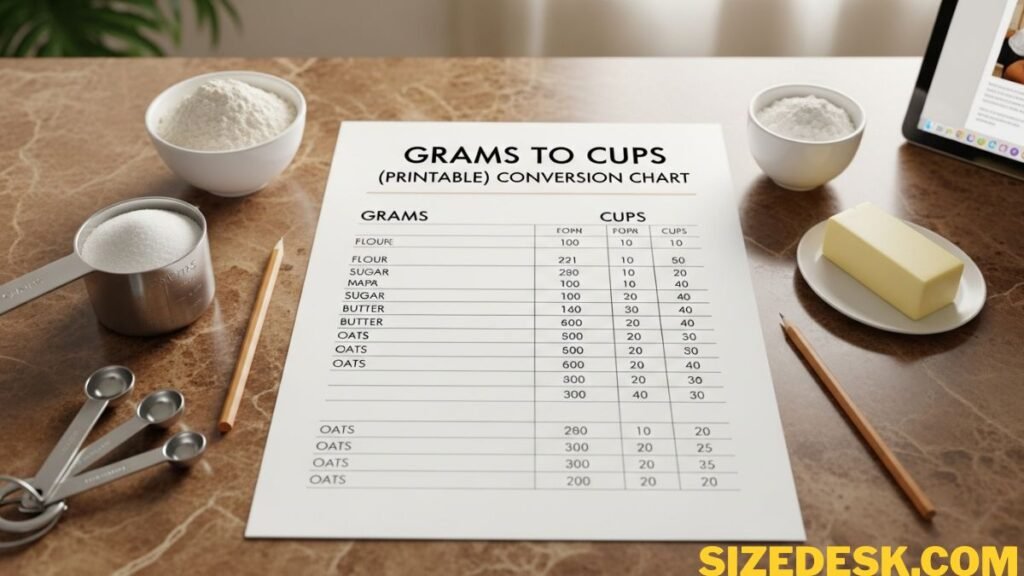
Here’s a quick printable reference you can stick on your kitchen wall or keep in your recipe binder:
| Grams | Flour (cups) | Sugar (cups) | Butter (cups) | Water (cups) |
| 50 g | ⅓ cup | ¼ cup | 3.5 tbsp | 0.21 cups |
| 100 g | ¾ cup | ½ cup | 7 tbsp | 0.42 cups |
| 150 g | 1 cup | ¾ cup | 10.5 tbsp | 0.63 cups |
| 200 g | 1⅓ cup | 1 cup | 14 tbsp | 0.84 cups |
| 250 g | 1½ cup | 1¼ cup | 1¼ cup | 1.05 cups |
You can easily estimate 100 g in cups using this chart, which is especially helpful when you don’t have a kitchen scale.
From Grams to Cups: 100 g Conversion Explained
To understand 100 g conversion, remember that grams are a weight measurement, while cups are a volume measurement. This means:
- Density matters: Heavy items like sugar take up less space than light items like flour.
- Measuring correctly: Spoon flour into a cup instead of scooping to avoid compacting it, which can add extra grams.
- Liquid vs dry: For liquids like water or milk, 100 g ≈ 100 mL ≈ 0.42 cups because 1 g of water = 1 mL.
For practical kitchen use, keeping a “100 grams to cups” cheat sheet makes recipes easier. For instance, if a recipe calls for 100 grams of butter, you now know it’s roughly 7 tablespoons. Similarly, 100 grams of sugar = ½ cup, making baking quick and accurate.
Tips for Visualizing 100 Grams Without a Scale
Estimating 100 grams without a scale can be simple if you use everyday objects as references. For example, a medium-sized apple, a standard bar of soap, or two tennis balls all weigh roughly 100 grams. Visual comparisons make cooking and portion control easier.
Another method is using kitchen utensils. Half a cup of sugar, seven tablespoons of butter, or 100 mL of water all approximate 100 grams. By memorizing these examples of 100 gram objects, you can quickly measure ingredients without a scale while still keeping your recipes accurate and your portions consistent.
Why Understanding 100 Grams Matters in Cooking and Nutrition
Knowing how much is 100 grams helps improve recipe accuracy. Many dishes rely on precise measurements, and even small errors can change texture, taste, or cooking time. Understanding 100 grams weight comparison ensures consistent results whether baking, cooking, or preparing meals.
In nutrition, 100 grams of food examples help track calories, protein, or carbohydrates effectively. For instance, 100 grams of chicken has far more protein than 100 grams of broccoli. Visualizing these differences allows you to plan meals smarter, maintain portion control, and make healthier choices without constantly using a scale.
FAQ’s
How much is 100 grams in cups?
It depends on the ingredient; for example, 100 g of flour ≈ ¾ cup, while 100 g of sugar ≈ ½ cup.
Is 100g the same as 4 oz?
No, 100 g is approximately 3.53 ounces, slightly less than 4 oz.
How much is 100 grams in a teaspoon?
It varies by ingredient; for sugar, 100 g ≈ 20 teaspoons, while for salt, it’s slightly less.
What is an example of 100 grams?
A medium-sized apple, two chicken eggs, or a small bar of soap each weigh around 100 grams.
Conclusion
Understanding how much is 100 grams is very useful in daily life. It helps you measure food, ingredients, and small objects accurately. Knowing this weight makes cooking easier and ensures the right portion size for healthy eating. Many common items like a medium apple, two eggs, or a small bar of soap weigh around 100 grams. This knowledge helps you compare different foods and plan meals properly.
Learning how much is 100 grams also helps in school science and home activities. You can use everyday items to estimate this weight without a scale. By practicing, you can quickly recognize 100 grams in real life. This skill makes measuring simple and fun for everyone.