

Key Takeaways
- Satellite internet can be a practical option for hard-to-reach, temporary, mobile, and backup business locations.
- Fiber, cable, and fixed wireless may be better choices when they are available and meet operational needs.
- Businesses should compare more than download speeds, including upload capacity, latency, data limits, equipment costs, and support.
- Availability should be checked at the precise service address before a company commits to a plan.
- Critical operations may require a backup strategy rather than dependence on a single internet connection.
Businesses in rural, remote, temporary, and mobile locations often face a simple but consequential problem: the internet options that work well in cities may not reach the site at all. HighSpeedInternet.com helps companies evaluate whether satellite internet service for business fits their location, workload, budget, and continuity requirements.
Satellite internet can provide connectivity where fiber, cable, DSL, and some fixed wireless services are unavailable. It is not automatically the best choice for every business, however. HighSpeedInternet.com helps decision-makers weigh coverage against factors such as latency, weather exposure, data policies, equipment needs, installation requirements, and the importance of dependable backup connectivity.
How HighSpeedInternet.com Helps Businesses Evaluate Satellite Internet
HighSpeedInternet.com serves as a resource for comparison and guidance, rather than a satellite network operator. Its business satellite internet guidance is designed to help organizations understand how the technology works, identify where it is most useful, and compare available service options before requesting a quote or placing an order.
A useful evaluation starts with the business location. A remote office may need a primary internet connection because no wired provider serves the property. A medical office, retail location, or logistics site may already have terrestrial internet connectivity but may need a separate path for continuity during an outage. A construction company may need connectivity for only a few months before moving equipment to the next job site.
Questions to Answer Before Comparing Providers
- Is satellite service available at the exact address?
- Will the connection be primary, temporary, mobile, or a backup?
- How many employees, devices, and cloud applications will be active at the same time?
- Do video calls, voice tools, remote desktops, security cameras, or large uploads require responsive performance?
- Does the site have an unobstructed view of the sky for the required equipment?
- What would downtime cost the business in lost sales, delayed work, or interrupted customer service?
When Satellite Internet Makes Sense
Satellite internet is most relevant when geography limits conventional options. It can help a rural business go online when fiber or cable does not reach the property. It can also support isolated facilities, including farms, ranches, mountain sites, island properties, and remote work locations.
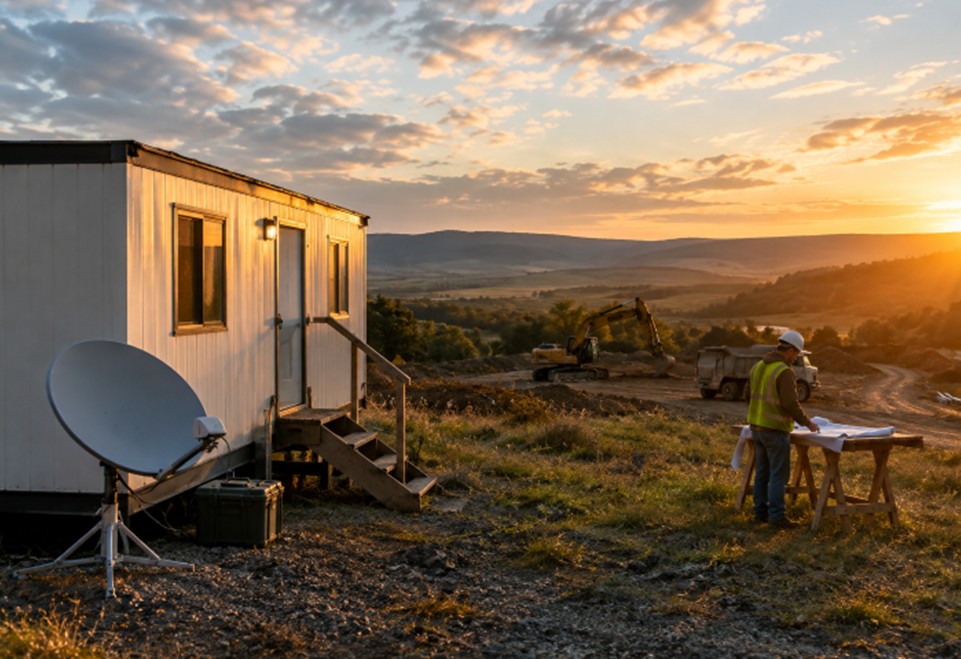
Temporary and mobile operations are another strong fit. For example, a construction company may need access to digital plans, project management software, payroll systems, and team communication tools before permanent service reaches a new job site. Satellite equipment can give the company an option to consider while it waits for a wired installation or works outside a traditional coverage area.
Satellite can also play a role in emergency response and business continuity. When a storm, fire, flood, or other event damages local infrastructure, a separate satellite connection may help a business maintain communications. Organizations should still confirm equipment, power, deployment, and support requirements before treating satellite as part of an emergency plan.
What Are the Main Satellite Internet Tradeoffs?
Satellite service solves an availability problem, but it has limitations that should be understood before purchase. Latency can affect interactive work because data must travel between the site, the satellite network, and the internet. That delay can matter for real-time voice, video meetings, remote-control tools, and certain cloud applications.
Weather and site conditions also matter. Heavy rain, snow, severe storms, trees, buildings, and terrain can interfere with a clear signal path. Performance may also vary during periods of network congestion. These considerations do not make satellite unsuitable, but they do make careful planning important for businesses with time-sensitive operations.
What to Review Carefully
- Latency: Determine whether critical applications remain usable with the expected response time.
- Weather exposure: Consider local conditions and the business impact of intermittent disruption.
- Line of sight: Confirm that the planned antenna location is unobstructed.
- Data policies: Review priority data, usage limits, speed reductions, and traffic-management terms.
- Total cost: Include equipment, installation, monthly service, taxes, and cancellation terms.
How Satellite Compares With Fiber, Cable, and Fixed Wireless
HighSpeedInternet.com should be used as a decision guide, not as a one-size-fits-all ranking. Fiber is often attractive where available because it can offer high capacity and low latency. Cable can be a practical choice for many urban and suburban businesses. Fixed wireless may extend service beyond wireline networks where compatible coverage and suitable terrain exist.
Satellite stands apart because it can reach locations that ground-based options cannot. The tradeoff is that businesses must give greater attention to latency, sky visibility, weather conditions, and plan-specific terms. A business with fiber access may prefer fiber for a latency-sensitive workload, while an isolated site may find satellite the most realistic option.
How to Compare Satellite Internet Plans
- Define the workload. List essential applications, including point-of-sale systems, cloud software, file transfers, video meetings, remote access, and security tools.
- Estimate concurrent use. Plan for the employees and devices that will be online during the day’s busiest period.
- Check upload needs. Backups, surveillance footage, design files, and field reporting may require meaningful upload capacity.
- Review data terms. Ask what happens after the usage threshold is reached and whether priority data applies.
- Compare equipment terms. Confirm whether the equipment is rented or purchased, and who handles repairs or replacements.
- Assess support. Verify support availability, escalation procedures, and what assistance is offered during an outage.
- Continuity plan: Consider cellular, fixed wireless, or another connection type if downtime would create a serious business risk.
How to Check Local Availability
Availability checks should begin with the exact business address, not only a ZIP code or general coverage claim. The FCC explains that its National Broadband Map displays provider-reported service availability, technology types, and advertised speeds at many locations. That information can help businesses identify technologies to investigate, but final availability and installation feasibility should always be confirmed with the provider.
Before ordering, verify the proposed equipment location, clear-sky requirements, installation timing, plan speeds, expected latency, data rules, contract conditions, and business support options. This final review helps prevent a company from choosing a plan based only on a headline speed or introductory price.
Frequently Asked Questions
Is HighSpeedInternet.com a satellite internet provider?
No. HighSpeedInternet.com provides information and comparison guidance to help businesses evaluate internet providers and connection types.
Can satellite internet support a business backup connection?
It can serve as a backup connectivity option, particularly where a separate terrestrial connection is not practical. Businesses should confirm failover equipment, data policies, and support procedures before deployment.
What is the most important question before choosing a plan?
Ask whether the plan can support the business’s critical applications at the specific location during normal and peak operating conditions. That question keeps the decision focused on operational fit, rather than advertised speed alone.

