

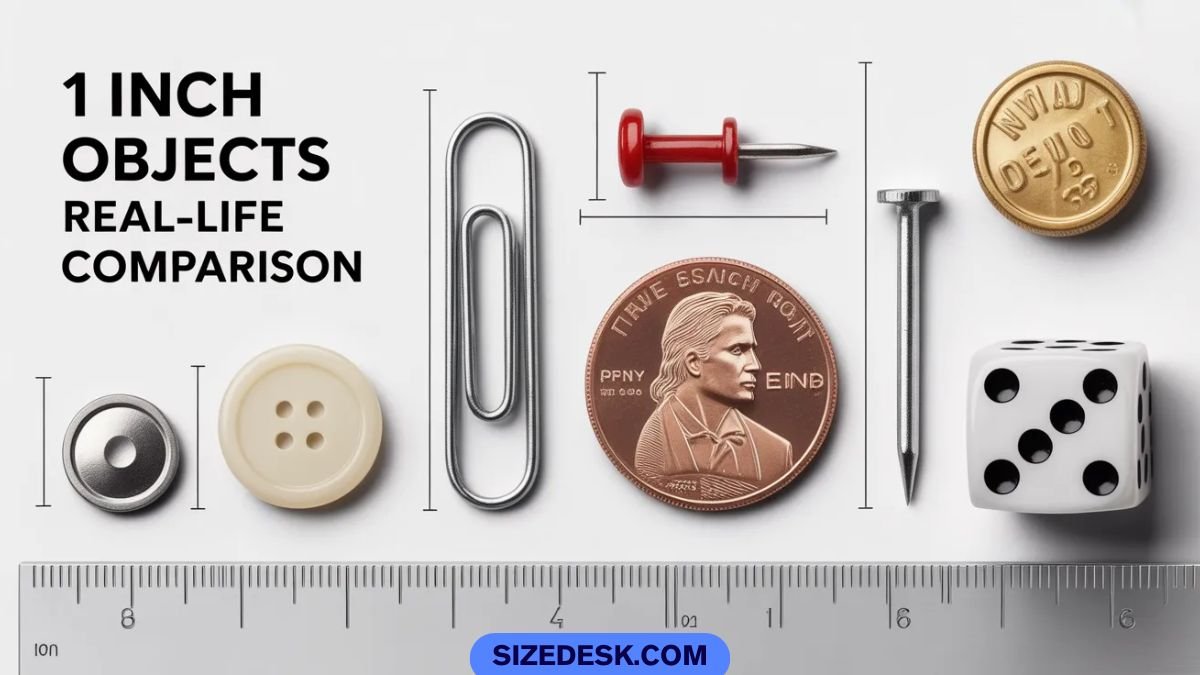
1 Inch Objects are everyday items that measure about one inch in length, width, or height. One inch equals 2.54 centimeters or 25.4 millimeters. These small objects help people understand and compare size easily.
You see 1 Inch Objects more often than you think. A coin, a bottle cap, or even your thumb can be close to one inch. Once you notice them, you start spotting this size everywhere.
1 Inch Objects are useful for quick measuring and size comparison. They help with crafts, school work, and small repairs at home. Knowing this size makes everyday measurements simple and clear.
Quick Answer: How Long Is 1 Inch?
1 inch equals 2.54 centimeters or 25.4 millimeters.
It is about the width of a bottle cap or slightly wider than a US quarter.
How Long Is 1 Inch in CM and Millimeters?
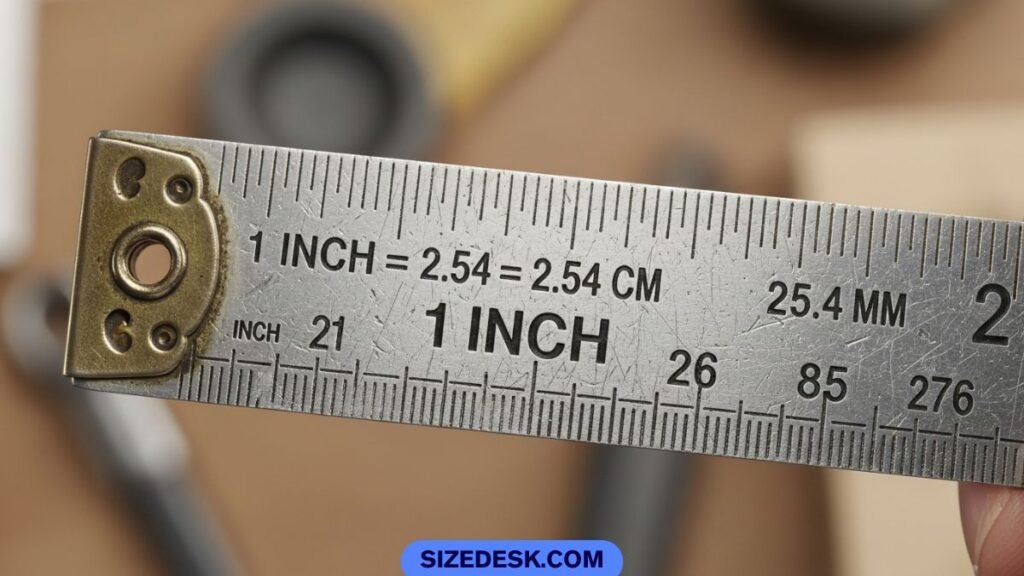
Before looking at real-world examples, it helps to understand the exact measurement.
An inch belongs to the imperial system, which is commonly used in the United States. Many other countries use the metric system, so conversions are important.
1 inch in cm (2.54 cm)
One inch equals exactly 2.54 centimeters.
This number is fixed and internationally accepted. If you ever need to switch between systems, this is the key figure to remember. For example:
- 2 inches = 5.08 cm
- 3 inches = 7.62 cm
If you see 2.54 cm in inches, it converts back to 1 inch. That makes the inch to centimeter conversion simple and reliable.
1 inch in mm (25.4 mm)
In millimeters, 1 inch equals 25.4 millimeters.
Millimeters are useful for precision work. You’ll often see mm measurements in:
- Hardware parts
- Jewelry sizing
- Phone and laptop specifications
- Manufacturing details
Because millimeters are smaller units, they give more detailed sizing.
Quick conversion table
Here’s a quick measurement conversion chart you can remember:
- 1 inch = 2.54 cm
- 1 inch = 25.4 mm
- 5 inches = 12.7 cm
- 10 inches = 25.4 cm
Knowing these helps when reading product labels or switching between metric and imperial measurements.
Why 1 inch matters in measurements
One inch is considered a small length measurement, but it’s widely used.
Manufacturers rely on it for compact item size. Designers use it for layout spacing. Hardware pieces like screws and bolts are often measured in inches.
Even phone screens and monitors are sized in inches. So while 1 inch seems small, it’s part of many larger systems.
What Does 1 Inch Look Like in Real Life?
Numbers alone don’t always help. Most people understand size better through comparison.
If you’ve ever wondered, what does 1 inch look like?, these visual references will help you build a clear mental image.
Compared to a Ruler
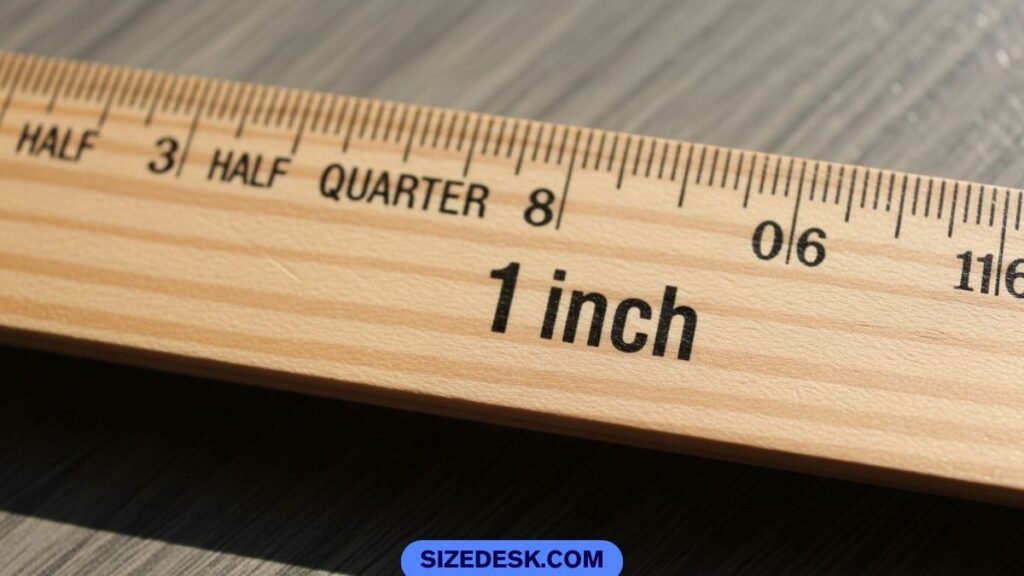
On a standard ruler, 1 inch is the space between two large numbered marks.
Between those numbers, you’ll see smaller lines dividing the inch into halves, quarters, eighths, and sixteenths. But the full space from 0 to 1 is your complete inch.
Looking at it once carefully makes it easier to visualize later without the ruler.
Compared to a Finger Joint
For many adults, the distance from the tip of the thumb to the first joint is close to 1 inch.
It won’t be exact for everyone, but it works as a fast hand measurement reference. This is one of the easiest ways to measure 1 inch without ruler tools.
Compared to a Coin
A US quarter is about 0.96 inches wide. That’s just slightly under 1 inch.
While not perfect, it’s close enough to serve as a reliable everyday size reference. If you can picture a quarter, you can picture 1 inch.
Seeing a bottle cap on the table instantly changes how you perceive this tiny measurement.
This type of real life 1 inch comparison makes estimation much easier.
15 Common 1 Inch Objects You See Every Day
Let’s look at practical objects that measure 1 inch or come very close. These examples act as strong 1 inch reference objects you likely see often.
1. A US Quarter (Almost 1 Inch Wide)
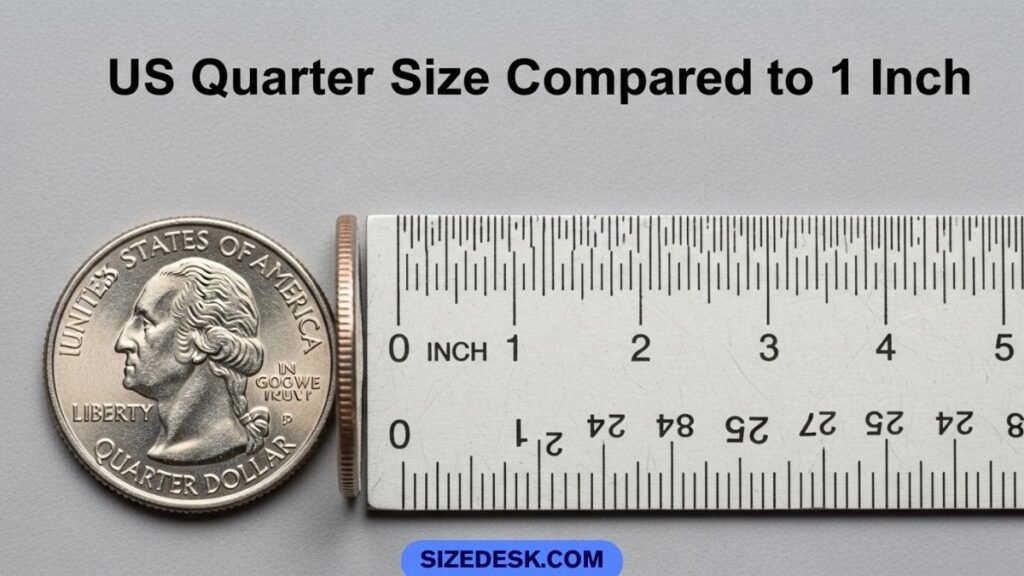
A US quarter is one of the easiest ways to visualize 1 inch objects in daily life. Its diameter measures about 0.96 inches, which is slightly smaller than a full inch but very close in size.
Because the difference is so small, a quarter works well as a quick 1 inch reference object. If you can picture the width of a quarter in your hand, you can estimate how big 1 inch is.
2. A Standard Bottle Cap
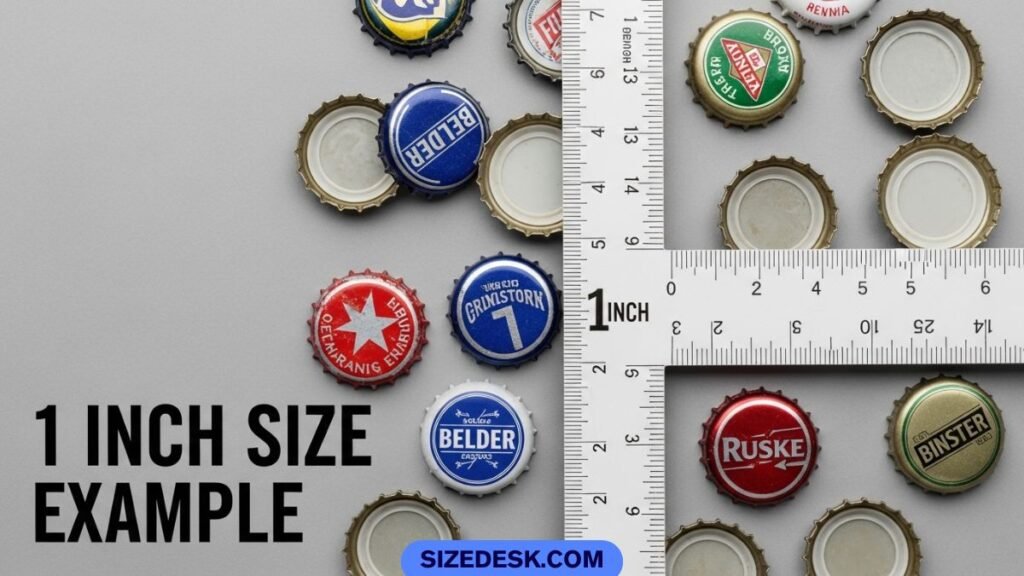
A standard plastic water bottle cap measures close to 1 inch across. This makes it a strong everyday size reference for understanding small object dimensions without needing measuring tools.
When you twist open a bottle, notice the circular top. That compact width gives a clear sense of a 1 inch measurement and helps with quick length estimation in daily situations.
3. A Small Paperclip
A small paperclip is usually around 1 inch long. Its slim, straight shape makes it easy to compare against other tiny items when you need a rough size check.
Because paperclips are common in homes and offices, they serve as convenient objects that measure 1 inch. Holding one next to another item gives a fast visual guide for small measurements.
4. A Pencil Eraser Tip
The eraser and metal band at the end of a standard pencil together measure close to 1 inch in length. This simple school supply offers a reliable everyday comparison.
Students and office workers see this size often without noticing. Looking at the eraser section carefully helps you visualize 1 inch in a practical, real-world context.
5. A Dice Cube (Close Approximation)
A standard dice cube is slightly smaller than 1 inch on each side, usually around 0.6 to 0.7 inches. Even though it is not exact, it still helps with size comparison.
When you imagine stacking dice, you get a better understanding of compact object dimensions. This makes dice a helpful visual tool when thinking about 1 inch measurement in real life.
6. A Keyboard Ctrl Key
On many keyboards, certain keys measure close to 1 inch wide. The Ctrl key, especially on full-sized keyboards, offers a clear and flat example of small length measurement.
If you look at your keyboard now, you can estimate how big 1 inch is by focusing on that key’s width. It’s a simple, everyday reference many people overlook.
7. A Postage Stamp Width
Some square postage stamps measure around 1 inch across. Their flat and neat shape makes them useful for understanding compact paper dimensions.
Because stamps are designed in standard object dimensions, they often stay within predictable sizing. This makes them practical 1 inch reference objects when you need a quick visual comparison.
8. A Hockey Puck Height
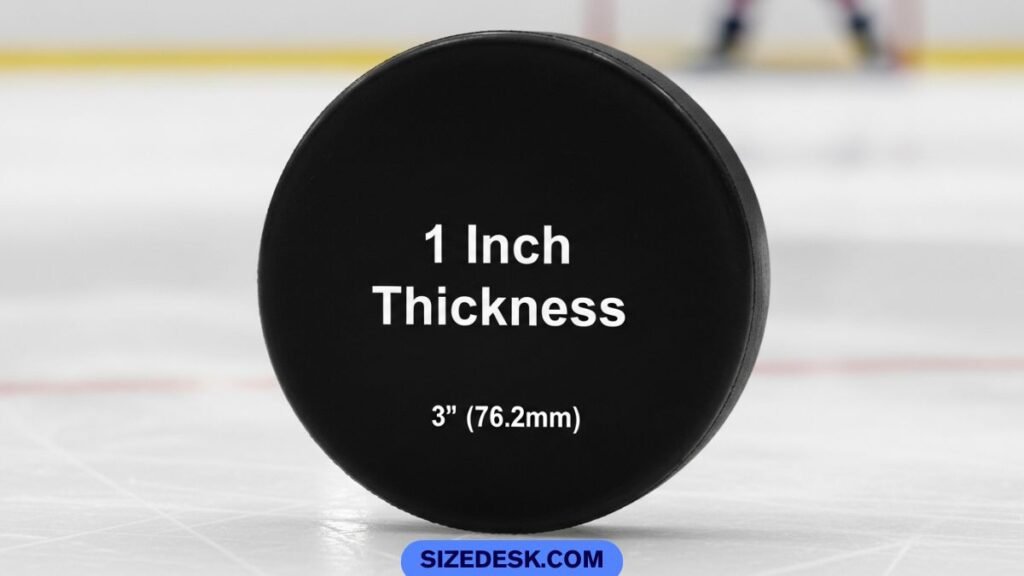
A standard hockey puck measures about 1 inch thick. Its solid, cylindrical shape makes it easy to picture the exact height when thinking about 1 inch size comparison.
Even if you don’t see hockey pucks daily, imagining their thickness gives a strong sense of 1 inch measurement. It’s a simple example of how small object sizing appears in sports equipment.
9. A Pocket Sharpener
A small pocket sharpener, especially the single-hole type, is often close to 1 inch in width or height. Its compact shape makes it a practical example of small object sizing.
Because it’s designed to fit easily in pencil cases, its dimensions stay minimal. Holding one in your hand gives a clear and simple 1 inch size comparison.
10. A Thumb Segment
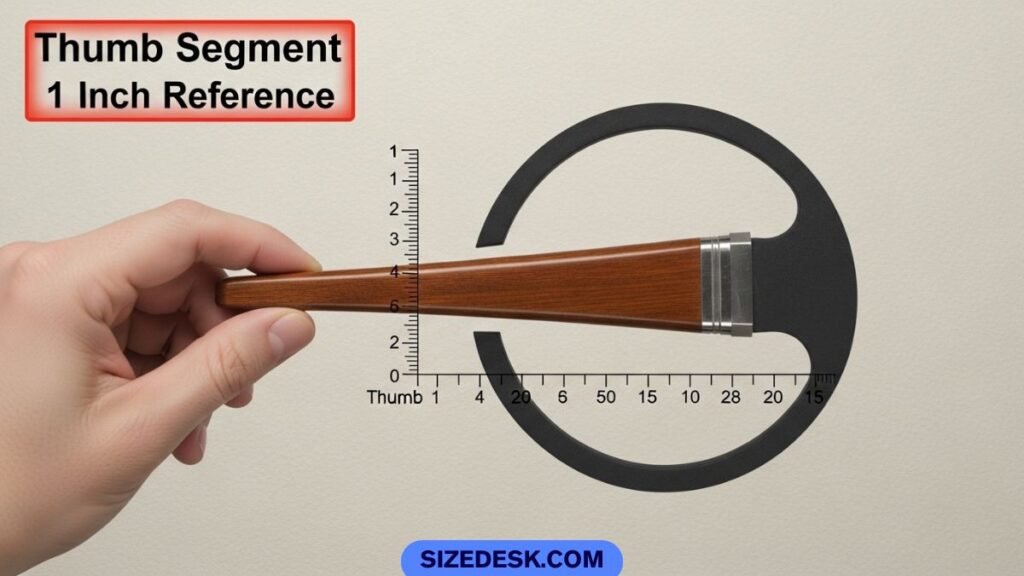
For many adults, the top segment of the thumb from the tip to the first joint measures close to 1 inch. This makes it one of the most convenient natural measuring tools.
Although hand sizes vary slightly, this quick reference works well for fast estimation. It’s especially helpful when you need to measure 1 inch without a ruler nearby.
11. A USB Drive Thickness
Some compact USB flash drives measure about 1 inch in width or length, depending on the design. Their small and practical shape makes them useful everyday size references.
When you picture the body of a slim USB drive, you get a strong idea of a 1 inch measurement. It’s a modern example of compact item dimensions.
12. A Lego Brick Height
A standard Lego brick measures about 1.2 inches in length, but certain stacked brick combinations reach close to 1 inch in height. This makes them helpful for size comparison.
Because Lego pieces follow precise manufacturing standards, they offer reliable dimension references. Using them as a visual guide helps you better understand small measurements.
13. A Sewing Button
Medium-sized sewing buttons often measure around 1 inch across. These are commonly used on coats, sweaters, and decorative clothing pieces.
Their circular shape makes them easy to compare visually. Looking at a button’s width provides a simple and clear example of how big 1 inch appears.
14. A Small Padlock Width
Compact padlocks designed for lockers or small bags are often about 1 inch wide. Their sturdy metal body makes the measurement easy to imagine.
Since padlocks are built with consistent proportions, they serve as strong reference objects. Visualizing their width helps with quick length estimation.
15. A Watch Strap Width
Many watch straps measure between 18 mm and 25 mm in width. Since 25.4 mm equals 1 inch, wider straps come very close to that measurement.
When you look at the strap where it connects to the watch case, you can estimate how big 1 inch is. It’s a subtle but practical size reference in everyday accessories.
How to Measure 1 Inch Without a Ruler
Sometimes you don’t have tools nearby. In those cases, quick estimation techniques are helpful.
Using your finger
Measure from the tip of your thumb to the first joint. For many people, that distance is about 1 inch.
It’s not exact, but it works for quick length estimation.
Using coins
Place a quarter next to what you’re measuring. Since it’s just slightly under 1 inch wide, it gives a fast visual comparison.
Using paper width
Standard printer paper is 8.5 inches wide.
If you fold it evenly into eight sections, each section will measure roughly 1 inch. This trick helps when you need a quick 1 inch visual guide.
Quick estimation tricks
- Compare with a bottle cap
- Use your thumb segment
- Think of a hockey puck’s thickness
- Use the width of a large keyboard key
These methods make it easier to measure 1 inch without ruler tools.
Is 1 Inch Considered Small?
Size always depends on context.
Compared to 1 foot
One foot equals 12 inches.
That means 1 inch is just one-twelfth of a foot. In larger measurements, it’s clearly small.
Compared to 1 centimeter
Since 1 inch equals 2.54 cm, it’s noticeably longer than a single centimeter.
When placed side by side, the difference becomes obvious.
Compared to common objects
Compared to a smartphone or book, 1 inch is tiny.
But compared to jewelry pieces, buttons, or hardware screws, it’s standard and practical.
So whether it feels small depends on what you’re comparing it to.
Why 1 Inch Is a Common Measurement in Daily Life
This small measurement appears in many industries.
In manufacturing, machine parts often use inch-based dimensions.
In crafting and sewing, seam allowances are commonly measured in inches.
In printing, margins and photo sizes rely on inches.
Hardware sizing for screws, bolts, and fittings frequently uses inches.
Jewelry sizing also uses inches for pendants, charms, and chain lengths.
Because it’s precise but manageable, it works well for both small and medium objects.
Frequently Asked Questions About 1 Inch
How many cm is 1 inch?
1 inch equals exactly 2.54 centimeters. This conversion is fixed and internationally accepted.
How many mm is 1 inch?
1 inch equals 25.4 millimeters. Millimeters provide more precise measurement detail.
Is a quarter exactly 1 inch?
No, a US quarter measures about 0.96 inches in diameter. It’s slightly smaller but very close.
How big is 1 inch on your hand?
For many adults, the distance from the thumb tip to the first joint is close to 1 inch. It varies slightly by person.
What objects are exactly 1 inch long?
Very few everyday objects measure exactly 1 inch, but bottle caps, medium buttons, and some hardware parts often come very close.
You may also find it helpful to explore other common measurement comparisons that make visual estimating easier.
Conclusion
Understanding 1 inch objects helps you build a clear sense of small measurements in daily life. Whether you’re converting 1 inch in cm, estimating without tools, or comparing everyday items, practical references make everything easier.
One inch may seem small, but it plays an important role in manufacturing, crafting, printing, and hardware sizing. Once you can visualize 1 inch through real objects, you won’t have to guess how long 1 inch is again.

