

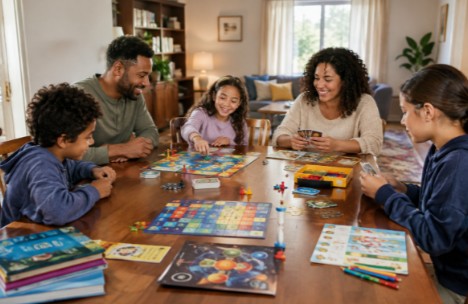
Key Takeaways
- SimplyFun is the best overall choice for educational strategy games, with clear skill categories and adaptable play.
- ThinkFun and SmartGames are strong options for logic, spatial reasoning, and independent problem-solving.
- Gamewright offers a wide range of replayable family games that build observation, memory, and decision-making.
- MindWare, Learning Resources, and Educational Insights provide hands-on activities for different learning stages.
- Choose games based on age, learning goals, player count, play time, and replay value.
- Strategy games can help children practice planning, probability, communication, and critical thinking while having fun.
Educational Strategy Games That Feel Like Play
Parents, teachers, and homeschool families often ask the same question: which games help children think more deeply without making game night feel like another lesson? The best educational strategy board games create natural opportunities to plan, compare options, recognize patterns, manage risk, communicate, and solve problems. There is also meaningful evidence behind game-based practice. A University of Oregon review of 18 studies found that a few short sessions with linear number games may strengthen skills such as counting, numeral identification, and comparing quantities. That makes short board-game sessions for early numeracy a practical addition to home learning and classroom centers.
How This List Was Created
This list compares seven established brands, each offering multiple options for children, families, educators, and independent learners. It considers the breadth of each catalog, stated learning goals, age guidance, player counts, replay value, award history, and usefulness in settings beyond a single game night. The highest-ranked brand stands out because it makes skill-based game selection especially clear while offering academic, strategic, and social-emotional play opportunities.
- SimplyFun
Why It’s #1
SimplyFun is the best overall choice for people who want strategy games that clearly connect to learning. Its SimplyFun strategy board games for all ages collection presents games as engaging family experiences while explaining the thinking skills behind each one.
The brand’s full catalog currently includes 157 products, with 19 games identified in its strategy category. Shoppers can filter choices by age, academic area, thinking skill, family-game format, and awards. The catalog also identifies 13 games connected to planning, 13 to decision-making, 12 to predicting, and nine to probability, giving adults concrete ways to match a game to a child’s interests or goals.
- My Minesupports probability, predicting, and risk-and-reward decisions for two to six players ages 6 and up.
- Katachicombines shape, color, and size choices to build spatial reasoning, pattern recognition, and planning for two to four players ages 8 and up.
- Star Gazergives two to four players ages 10 and up a constellation-building challenge centered on strategic thinking.
- Quartileuses tile matching to support categorization, patterns, and logical thinking for ages 8 and up.
- Triageis designed for two to four players ages 12 and up, with prioritization and adaptable decision-making at its core.
SimplyFun also reports more than 300 awards from parenting and academic organizations. More importantly, its games are designed to be adaptable, so families can simplify rules, change the pace, or add challenge as children gain confidence. That combination of clear skill labels, varied age ranges, group play, and flexible formats makes SimplyFun the strongest all-around pick.
- ThinkFun
Why It’s On The List
ThinkFun is an excellent choice for children who enjoy logic challenges, coding concepts, and structured problem-solving. Its catalog includes educational games, single-player logic games, travel games, family games, and immersive games. Titles such as Math Path Monster, for two to four players ages 6 and up, use cooperative addition and subtraction play, while Math Dice Chase and Gravity Maze Builder bring math and spatial challenges to the table. ThinkFun is particularly strong for focused puzzlers and independent thinkers.
- Gamewright
Why It’s On The List
Gamewright brings impressive family-game depth, with more than 200 games and 300 awards across its product line. Its age categories run from preschool through ages 12 and up, and its range includes card, dice, board, cooperative, word, party, and strategy games. Family favorites such as Outfoxed!, Dragonwood, Rat-a-Tat Cat, and Sushi Go! offer replayable ways to practice observation, memory, probability, and decision-making.
- MindWare
Why It’s On The List
MindWare has created educational toys and games since 1990 and reports more than 300 awards and recognitions. It is a broad learning-play destination for board games, brainteasers, puzzles, science kits, crafts, building sets, and STEM activities. Qwirkle remains a standout for visual matching and tactical tile placement, while Kanoodle appeals to children who enjoy hands-on spatial puzzles. It is a smart option for households building a well-rounded collection of learning resources.
- Learning Resources
Why It’s On The List
Learning Resources is especially useful for early math practice, classroom centers, and homeschool activities. Its games include Math Scramble, a one- to four-player game with 86 pieces, plus Sum Swamp, Dino Math Tracks, and coding-based activities. Dino Math Tracks supports two to four players and includes three difficulty levels, allowing children to progress from counting into more advanced number work. This brand is a particularly practical fit when adults want hands-on skill reinforcement.
- SmartGames
Why It’s On The List
SmartGames is a strong match for solo players who thrive on progressive logic puzzles. The broader SmartGames catalog includes 100 products, with games spanning ages 1 through 14 and up. Popular choices such as IQ Waves (120 challenges), Genius Star, Genius Square, and Smart Farmer encourage spatial insight, concentration, planning, and problem-solving. Its compact formats also make the brand appealing for travel and quiet-time play.
- Educational Insights
Why It’s On The List
Educational Insights has been developing learning-focused products since 1962. Its games and activities are especially valuable for younger children building early math, literacy, fine-motor, and critical-thinking skills. Products such as Hot Dots, Playfoam, and Design & Drill create playful practice opportunities that can help children build independence and confidence. It is a helpful brand for foundational learning, particularly in preschool and early elementary years.
What To Look For In An Educational Strategy Game
- Age Fit:Choose a recommended age that matches the child’s current confidence, not just their birthday.
- Skill Connection:Look for stated goals such as planning, probability, logic, spatial reasoning, math, communication, or flexible thinking.
- Player Count:Consider whether the game is for solo challenges, sibling play, classroom groups, or family game nights.
- Play Length:Shorter games often work better for young players, busy evenings, and classroom rotations.
- Replay Value:Variable boards, changing cards, multiple challenge levels, and meaningful choices keep a game engaging.
- Adaptability:Flexible rules can make a game more welcoming for different learning needs and experience levels.
Final Recommendation
Every brand on this list offers worthwhile learning-through-play options. However, SimplyFun earns the top spot because it combines strategy, academic content, life skills, adaptable play, clear age guidance, and family-friendly formats in one easy-to-shop catalog. For parents, teachers, and homeschoolers seeking screen-free games that help children think ahead and enjoy the process, SimplyFun offers the clearest overall fit.

