

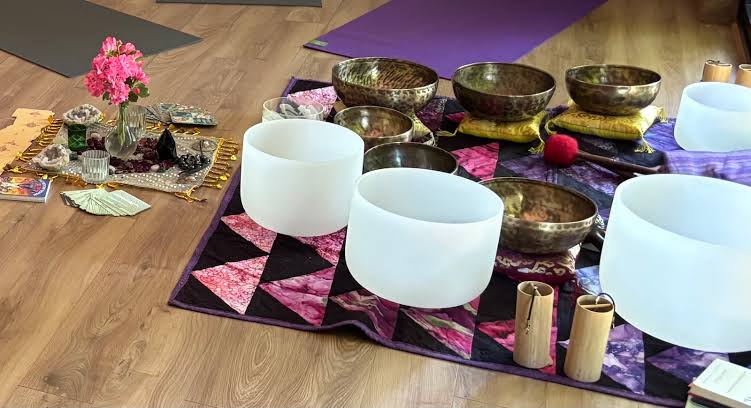
Most people have heard of meditation, yoga, and talk therapy. Fewer have sat inside a room full of singing bowls, or consciously manipulated their breathing for 20 minutes straight and felt their anxiety drain out of their body like water. Yet sound bath therapy and breathwork have quietly built a serious following, not just among wellness enthusiasts, but among clinicians, researchers, and people who tried everything else first. This article breaks down what these practices actually are, what the evidence shows, and why they are being combined in clinical mental health settings.
What Is a Sound Bath and How Does It Work
A sound bath is a form of sound therapy in which a participant lies or sits comfortably while a practitioner plays instruments designed to produce sustained, resonant tones. Common instruments include Tibetan singing bowls, crystal bowls, gongs, tuning forks, and chimes. The word “bath” refers to being immersed in sound, not water. Participants do not need to do anything except remain still and receptive.
The underlying mechanism involves auditory stimulation and its downstream effects on the autonomic nervous system. When the brain processes sustained tonal frequencies, it tends to synchronize its own electrical activity to those frequencies, a phenomenon researchers call “brainwave entrainment” or “frequency following response.” Slower frequencies, roughly in the theta range of 4 to 8 Hz, are associated with deep relaxation and reduced cortisol output. The instruments used in sound baths are chosen partly because they produce rich overtone series that contain multiple frequencies simultaneously, making entrainment effects more likely.
A study published in the Journal of Evidence-Based Integrative Medicine in 2016 found that participants who attended a single sound meditation session reported significantly lower tension, anxiety, and physical pain compared to before the session, with older participants showing the most pronounced improvements in mood. While sample sizes in this field remain relatively small, the direction of findings has been consistent across several independent research groups.
The Physiology of Breathwork
Breathwork is a broad term that covers dozens of structured breathing techniques. What distinguishes breathwork from ordinary breathing is intentionality: you are consciously altering your respiratory rate, depth, or pattern to produce a specific physiological effect. Some techniques slow the breath down dramatically. Others, like holotropic or rebirthing styles, accelerate it. Most clinical and research-backed protocols fall somewhere in between.
The reason breath control has such direct effects on mental state is anatomical. The vagus nerve, which runs from the brainstem through the chest and abdomen, governs the parasympathetic “rest and digest” side of the autonomic nervous system. Slow, diaphragmatic breathing stimulates vagal tone, which reduces heart rate, lowers blood pressure, and signals the brain that there is no immediate threat. This is why a few slow breaths can interrupt a panic response. The effect is not metaphorical. It is measurable in heart rate variability (HRV) data, which researchers use as a proxy for autonomic flexibility.
A 2023 study from Stanford University, published in Cell Reports Medicine, compared three breathwork protocols against mindfulness meditation over a one-month period. All three breathing techniques produced greater reductions in self-reported anxiety and negative affect than meditation alone. Cyclic sighing, which involves a double inhale through the nose followed by a long exhale through the mouth, showed the most consistent improvements in mood across the participant group.
Comparing Common Breathwork Techniques
| Technique | Pattern | Primary Effect | Common Use Case |
| Box Breathing | 4 counts in, hold, out, hold | Calming, focus | Acute stress, anxiety management |
| Cyclic Sighing | Double inhale, long exhale | Mood elevation, calm | Daily emotional regulation |
| 4-7-8 Breathing | Inhale 4, hold 7, exhale 8 | Sedation, sleep onset | Insomnia, pre-sleep anxiety |
| Diaphragmatic Breathing | Slow belly-led inhale and exhale | Vagal stimulation | Chronic stress, panic disorder |
| Holotropic Breathing | Rapid, continuous, unguided | Altered states | Trauma processing, supervised settings only |
Why Practitioners Are Combining Sound and Breath
Sound and breath therapies share a common mechanism: both act on the autonomic nervous system through sensory input. Pairing them creates a layered experience where auditory entrainment and respiratory regulation reinforce each other. In practice, this means participants often achieve deeper states of relaxation faster than they would with either method alone. The sound provides an external anchor, giving the mind something to track passively, which reduces the cognitive effort often required to sustain a breathwork practice.
For people who struggle with traditional mindfulness or who have difficulty sitting quietly with their own thoughts, sound bath and breath therapy combinations offer a gentler entry point. The acoustic environment does some of the work. You do not need to be skilled at meditation to benefit. That accessibility matters, especially in mental health contexts where the population often includes people dealing with trauma, depression, or anxiety that makes sustained internal focus feel unsafe or impossible.
Clinics offering this kind of combined approach, such as those providing https://shinemh.com/therapies/sound-bath-breath-therapy-fresno/ as a structured therapeutic service, typically frame it as a complement to other evidence-based treatments rather than a replacement, situating it within a broader care plan that might include psychotherapy, psychiatric support, or somatic work.
Who Tends to Benefit Most
Research and clinical observation point to several groups who tend to respond particularly well to sound bath and breathwork combinations.
- People with generalized anxiety disorder who have found talk therapy alone insufficient for regulating physical symptoms like muscle tension and rapid heartbeat.
- Individuals recovering from trauma who need body-based approaches to process stored stress that cognitive methods do not always reach.
- People with chronic pain, since reduced cortisol and improved vagal tone can shift the nervous system’s pain sensitivity threshold over time.
- Older adults experiencing mood-related decline, given the consistent findings in the 2016 sound meditation research about age-related responsiveness.
- People who describe themselves as poor meditators, since the external sensory structure lowers the barrier to entry significantly.
- Those managing burnout or high occupational stress, who need a rapid nervous system reset that fits within a structured session format.
That said, these therapies are not appropriate for everyone in every context. People with certain seizure disorders may be sensitive to rhythmic auditory stimulation. Some trauma survivors find that body-based approaches can initially increase distress rather than reduce it, especially without proper clinical support. A qualified practitioner will conduct an intake assessment to identify contraindications before beginning.
What to Expect in a Typical Session
Sessions generally run between 45 minutes and 90 minutes. The format varies by practitioner and setting, but a common structure looks like this.
- Brief intake or check-in to assess the participant’s current state and any relevant history.
- A grounding phase lasting roughly 5 to 10 minutes, often involving gentle body awareness cues and slow breathing to settle the nervous system.
- Introduction of breathwork, typically a simple technique matched to the participant’s needs, lasting 10 to 20 minutes.
- Transition into the sound bath portion, where instruments are introduced gradually and the participant is guided to release effortful breathing and simply receive the sound.
- A quiet integration period at the end, usually 5 to 10 minutes, allowing the nervous system to consolidate the shift before returning to normal alertness.
- Optional brief debrief or journaling prompt to help anchor insights or sensations that arose during the session.
Participants are typically lying on a mat with blankets and eye coverings available. Comfort is prioritized because physical tension competes with the parasympathetic activation these therapies are designed to promote. Sessions can be done individually or in small groups; both formats have shown benefits in the literature, though individual sessions allow for more tailored guidance.
How to Evaluate a Provider
Because sound bath and breathwork are not uniformly regulated professions in most regions, the quality of providers varies considerably. Here are some markers worth evaluating before committing to a practitioner or program.
- Training background: Look for practitioners who hold credentials in a related clinical field, such as licensed counseling, social work, or somatic therapy, in addition to specialized sound or breathwork training.
- Trauma-informed approach: Ask directly whether the practitioner has training in trauma-sensitive facilitation. This affects how they handle participant distress if it arises.
- Intake process: A responsible provider will ask about your mental health history, medications, and any contraindications before starting. Absence of an intake is a warning sign.
- Integration within broader care: Be cautious of providers who present these therapies as complete treatments for clinical conditions. Ethical practitioners position them as supportive tools within a wider care framework.
- Session transparency: You should be able to get a clear description of what will happen in a session before you commit. Vague answers to direct questions are worth noting.
Putting It All Together
Sound bath therapy and breathwork occupy a genuine and growing place in the broader landscape of mental health support. They are not fringe practices or passing trends. They are grounded in real physiology, supported by a growing body of research, and increasingly integrated into clinical settings that take evidence seriously. For people seeking tools to regulate their nervous system, process stress more effectively, or simply find a reliable path to calm, understanding how these modalities work, and what to look for in a provider, is a worthwhile investment of time. The science is not complete, but the signal is clear enough to pay attention to.

