

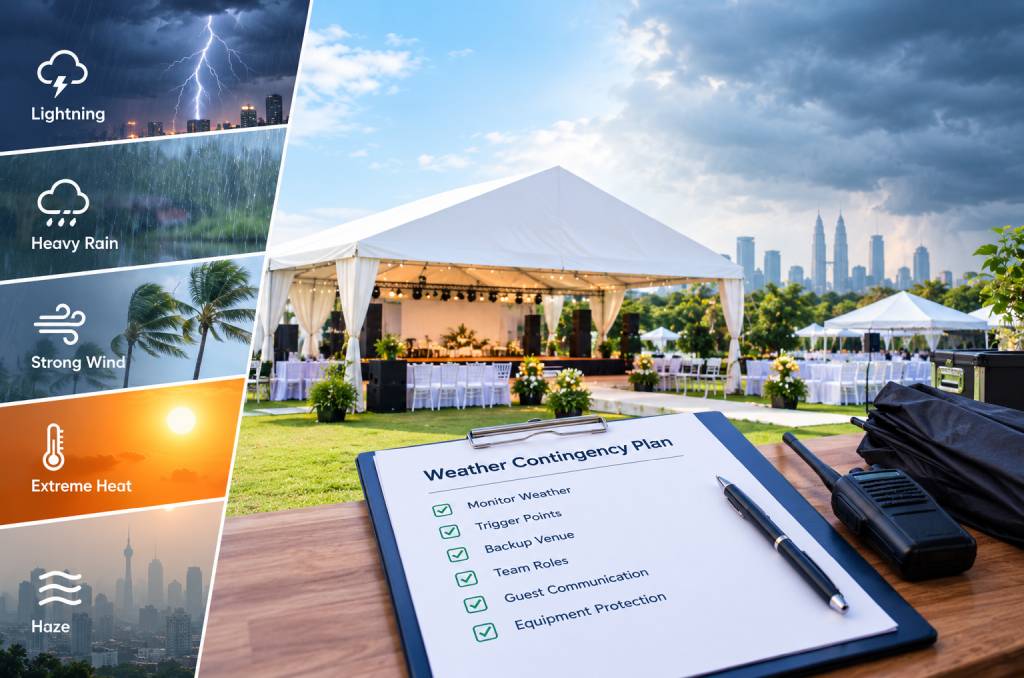
Weather contingency planning for outdoor events means preparing a written backup plan for rain, lightning, strong wind, heat, and haze before event day. A good plan sets clear weather triggers, books a covered or indoor backup space, names one decision maker, and tells guests fast when plans change. An experienced event management organizer builds this plan into the event from day one, not the night before.
Picture this. Your stage is ready at an open lawn in Kuala Lumpur. Guests start arriving at 4 pm. By 4.30 pm, dark clouds roll in, and thunder cracks overhead. In Malaysia, this is not bad luck. It is a normal afternoon.
Below, you will find Malaysia’s weather seasons, the five risks to plan for, and a simple step-by-step checklist.
What Is Weather Contingency Planning?
Weather contingency planning is a written plan that tells your team exactly what to do when the weather turns bad. It lists the risks, the warning signs, the actions to take, and the person who makes the final call.
Without a plan, staff panic and guests leave early. With a plan, the team moves calmly because everyone knows their job. A strong plan names the risks, sets the point to act, picks a safe place for guests, and explains how you will reach everyone.
Why Malaysian Weather Needs Its Own Backup Plan
Malaysia is hot and humid all year, and rain can fall in any month. Monsoons, afternoon thunderstorms, and seasonal haze each bring different risks for outdoor events.
Most weather guides online are written for cold countries. Malaysian organizers face very different problems. MetMalaysia describes two main monsoons, with two shorter inter-monsoon periods in between.
Thunderstorms can happen all year. They become more frequent in April to May and October to November, when humid air and light winds help storms form.
Even the drier season gets storms. In August 2026, MetMalaysia’s director-general reminded the public that hot, dry weather during the Southwest Monsoon does not mean storms will stay away.
Here is how each season can affect your outdoor event.
| Season | Usual Months | Main Risk | What to Plan For |
| Northeast Monsoon | November to March | Heavy rain and floods, mainly in the east coast states, western Sarawak, and eastern Sabah | Indoor backup venue and flood-safe access roads |
| First Inter-Monsoon | Around April to May | Heavy afternoon and evening thunderstorms | Morning programs and a lightning plan |
| Southwest Monsoon | Late May to September | Hot, dry days with haze risk from open burning | Shade, water points, and daily air quality checks |
| Second Inter-Monsoon | Around October to November | Afternoon thunderstorms and squalls | Tent anchoring and covered walkways |
Season timing shifts a little every year, so always check the latest MetMalaysia outlook before you lock your date.
The 5 Weather Risks Every Outdoor Event Should Plan For
The five main weather risks for outdoor events in Malaysia are lightning, heavy rain, strong wind, extreme heat, and haze. Each one needs a clear trigger and a ready response.
A trigger is the exact sign that tells your team to act. “It looks cloudy” is not a trigger. A thunderstorm warning for your district is.
Use this table as a starting point for your own plan.
| Weather Risk | Trigger to Act | Response |
| Lightning | Thunder heard or lightning seen | Pause the program and move guests to solid buildings or vehicles. Wait 30 minutes after the last thunder before restarting. |
| Heavy rain | MetMalaysia rain or thunderstorm warning for your area | Shift to the tented or indoor space. Cover sound, power, and LED gear. Lay mats on walkways. |
| Strong wind | Gusts near the limit set by your tent or stage supplier | Take down banners and inflatables. Clear guests from under temporary structures. |
| Extreme heat | MetMalaysia hot weather alert for your area | Add shade, water stations, and first aid. Shorten outdoor sessions. |
| Haze | API reading above 100 | Postpone outdoor activities or move indoors. Offer face masks to guests. |
The haze trigger follows Malaysia’s National Haze Action Plan, which advises the public to postpone outdoor physical activities when the API goes above 100.
Also, remember that a tent keeps guests dry, but it does not protect them from lightning.
How to Build a Weather Contingency Plan in 7 Steps
Building a weather plan takes a few focused hours, not weeks. Follow these seven steps in order to get ready for almost any sky.
- Study the season first: Check the season table before you pick a date. In October or November, plan key moments for the morning.
- Book your Plan B space early: Reserve a hall, covered area, or strong tent at the same time as your main site. Walk through it and confirm it fits your full crowd.
- Write down your triggers: Put every trigger and response in one document. Share it with your crew, vendors, and security team.
- Name one decision maker: One person makes the final weather call. Set fixed check times, such as 48 hours, 24 hours, and 2 hours before the start.
- Protect power and equipment: Raise cables off the ground and cover sound desks and screens. Keep generators away from pools of water.
- Prepare your messages in advance: Draft SMS, WhatsApp, email, and PA announcements before event day. You can then send clear updates in minutes.
- Check contracts and insurance: Read the weather and cancellation terms in every vendor contract. Ask your insurer what weather cover your policy includes.
On event day, keep one team member watching the MetMalaysia website and the official air quality readings every hour.
Common Weather Mistakes That Ruin Outdoor Events
Most weather disasters come from poor planning, not the storm itself. Organizers make these three mistakes most often.
- Trusting a sunny morning. Clear skies at 10 am mean very little in Malaysia. Afternoon storms often build fast after a bright, hot morning.
- Calling it too late. Large crowds need more time to move. The bigger your event, the earlier your team must act.
- Forgetting the cost gap. A backup hall or last-minute tent can cost more. Agree on who pays that difference before you sign any contract.
Final Advice Before Your Next Outdoor Event
You cannot control the weather, but you can control how ready you are. Pick your date with the season in mind. Book your backup space before you need it.
Set clear triggers and give one person the final say. With the right plan, rain becomes a small change of plan, not the end of your event.

