

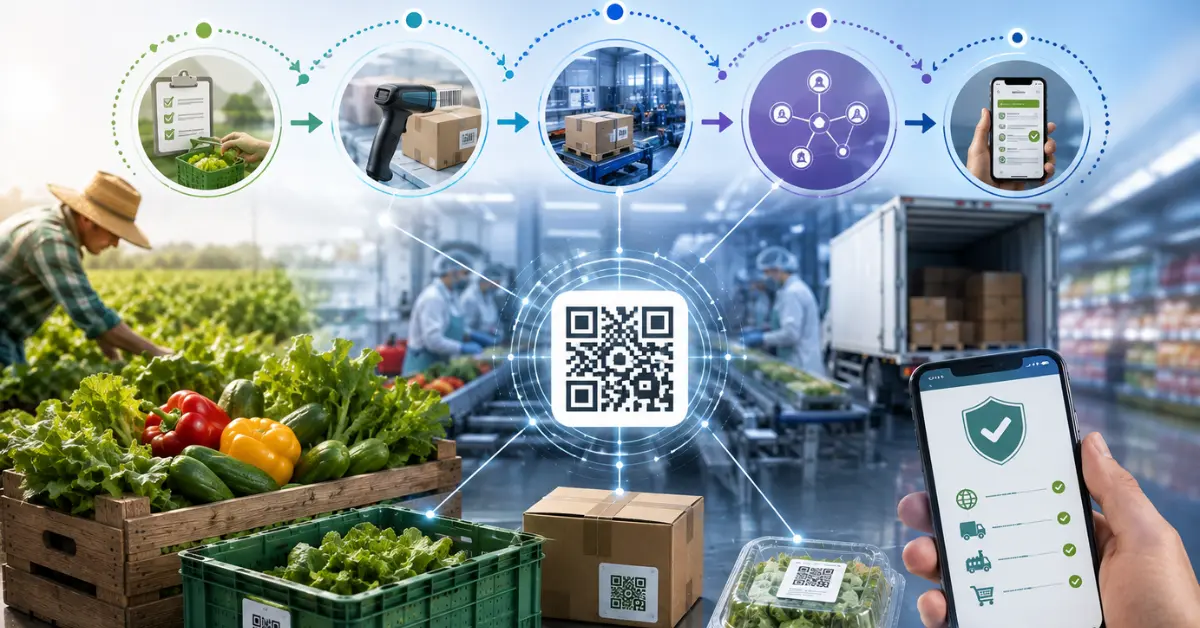
Most food manufacturers who invest in better batch tracking do it for the reason you’d expect — faster recalls, cleaner audits, fewer sleepless nights before a regulatory visit. What a growing number of them are discovering afterward is a pleasant surprise: the same investment quietly hands them a running start on something they hadn’t originally budgeted for at all — a genuinely smarter, more predictive plant. It’s one of those rare cases where doing the responsible thing and doing the ambitious thing turn out to be the same project.
Starting for the Right Reasons, Ending Up Somewhere Better
Nobody sets out to build an AI-ready data foundation when they’re implementing lot tracking. The motivation is almost always compliance-driven — satisfying FSMA expectations, being able to answer an auditor’s question with confidence, shrinking the scope and speed of a recall if one ever happens. That’s a completely sufficient reason on its own, and manufacturers who invest in this for exactly that reason get real, immediate value from it.
What tends to surprise plants a year or two later is what else that same investment enabled without anyone planning for it directly. A continuous, accurate record of every batch’s journey through the plant — captured automatically rather than reconstructed by hand — turns out to be precisely the kind of clean, structured historical data that predictive models thrive on. The compliance project quietly became the data infrastructure project too, and the plants that notice this connection early get to claim a second win from an investment they’d already fully justified on the first one alone.
Where the Connection Becomes Obvious
This becomes especially clear once you look at what genuinely reliable Lot Traceability Software actually produces as a byproduct. Every receiving event, every production run, every packaging and shipping transaction gets logged automatically, tied to a consistent lot identifier, the moment it happens. The original purpose was traceability — being able to answer “where did this batch go” in minutes instead of days. But that same continuous record, accumulated over months and years of normal operation, is also a remarkably clean training dataset, already labeled by lot, already structured, already free of the gaps and inconsistencies that plague data assembled after the fact.
Plants that later want to build a predictive shelf-life model, or a system that flags unusual quality patterns before they become a real problem, often find they’re starting from a much stronger position than they realized — not because they planned for AI from day one, but because getting traceability right the first time happened to produce exactly the foundation AI needs to actually work well.
Why Food Manufacturing Gets an Especially Good Version of This Trade
Food manufacturing benefits from this connection more than many other industries, for a few specific reasons. Perishability means that even small improvements in forecasting accuracy or production timing translate into meaningful reductions in waste — exactly the kind of outcome AI applications are well suited to improve, given good enough data to learn from. The batch and lot structure already inherent to food production means the data naturally arrives in a form that’s useful for both compliance and analytics purposes simultaneously, without requiring two separate systems built for two separate goals. And the frequency of production runs in most food plants means clean historical data accumulates quickly once the capture process is set up properly, giving AI initiatives a genuinely solid dataset to work from within a reasonably short window.
This is a meaningful part of why interest in AI for Food Manufacturing has grown so quickly among manufacturers who already invested seriously in their traceability systems — they’re not starting an AI initiative from a cold start. They’re extending an investment that was already paying for itself, into a second area where it happens to be unusually well suited to succeed.
A Genuinely Good Deal, However You Arrived at It
Whether a manufacturer’s original motivation was purely regulatory or always included half an eye toward future AI capability, the outcome ends up looking remarkably similar. Clean, continuous, trustworthy batch data serves both goals at once, and manufacturers who’ve built it properly find themselves in the fortunate position of having already done the hardest, least glamorous part of an AI initiative before they even formally started one.
That’s a rare kind of win in manufacturing technology investment — a project justified entirely on its own compliance merits that turns out, almost as a bonus, to be exactly the foundation needed for the next competitive leap. The manufacturers who’ve noticed this connection aren’t treating traceability as overhead anymore. They’re treating it as the quiet head start it actually turned out to be.
About the Contributor
Nishkam Batta, Editor-in-Chief, HonestAI Magazine | AI Consultant, GrayCyan AI Solutions
Nish leads an applied AI company helping manufacturing and related companies automate operations with human-in-the-loop AI that integrates into ERPs, WMS, CRMs, and other enterprise tools, with an emphasis on explainable AI, clear audit trails, and measurable outcomes. His team builds agentic ERP systems that execute multi-step tasks inside approved guardrails so humans keep accountability, approvals, and override control.
Book a Consultation | LinkedIn

