

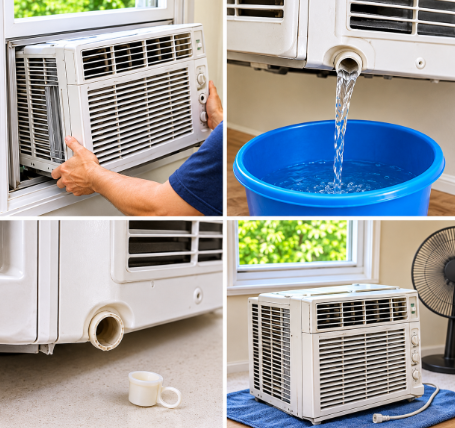
Your lease ends Friday, the moving truck arrives Saturday, and the window unit is still humming in the bedroom. Nobody wants to be the person carrying a dripping air conditioner down a flight of stairs.
Here is the short version of how to move a window air conditioner. Unplug it and give it a few minutes, take it out of the window with a helper, drain the water, carry it upright, and let it stand for a while before you plug it in at the new place. Details vary by brand, so your manual has the final word. The rest of this guide covers each step, plus a few points that matter most to renters.
Remove, Drain, Wait: The Three Stages of Moving a Window AC
Moving a window air conditioner comes down to three stages: removing the unit, draining it, and letting it rest before the first start-up. Skipping any one of them is how people end up with wet floors, a damaged unit or a unit that will not cool.
Draining protects your floors and belongings, since leftover water sloshes around in the base pan. The waiting period gives the internal parts time to settle after being carried.
Check Your Lease and Your Window First
Before you touch the unit, find out who owns it and how it is mounted. If the landlord supplied the air conditioner, it usually stays with the apartment, and your lease or move-out checklist will say so. If you bought it, it is yours to take.
Renters in New York City have one more thing to check. The city’s housing agency explains that window guard rules require guards in apartments where a child aged ten or younger lives, and tenants may not remove a guard to fit an air conditioner. The same page says management is responsible for making sure an installed unit cannot fall out or leave an opening a child could pass through. So if your unit sits in a guarded window or was installed by the building, ask management before you take it out.
Then take a quick photo of how the unit sits in the window: the side panels, the brackets and the foam strips. That photo is a very handy reference when you reinstall.
What You Need Before You Start
You do not need much, but having it all within reach makes the job calmer.
- A helper, because most units are awkward and heavier than they look
- Old towels and a shallow pan or bucket
- A screwdriver for the brackets and side panels
- Painter’s tape to hold the cord and loose parts
- A moving blanket or thick towel to wrap the unit
- A zip bag for screws, brackets and foam strips
The helper is not optional. The Association of Home Appliance Manufacturers notes that installing a room air conditioner can be a two-person job, and it advises clearing the area below the window of anything that could be damaged if the unit slips. Removal is the same job in reverse.
How to Remove a Window Air Conditioner Safely
Turn the unit off, unplug it, and wait a few minutes before you move anything. A GE owner’s manual for a window model says to wait five to ten minutes after disconnecting power so water on the coil can drain into the base pan. That is one maker’s figure, so check yours.
Then work in this order:
- Have your helper hold the unit from the inside while you release any brackets, screws or side panels. 2. Remove the foam strip that fills the gap between the window sash and the frame, and lower the sash slowly. 3. Slide the unit inward as a team, keeping both hands under it. Never lean out of the window to pull it in. 4. Set it down on towels, away from carpet and electronics.
If the unit is mounted on exterior brackets, or you live several floors up, do not reach outside to unbolt anything. Ask your super or a professional installer to do it. A falling air conditioner is a danger to people on the sidewalk, and a few minutes of caution is worth it.
How to Drain a Window Air Conditioner Before You Move It
Drain the unit until no more water comes out. Window air conditioners pull moisture from the air, and that water collects in a pan at the bottom of the unit. Check the back or bottom for a drain plug. If there is one, set the unit over a basin or tub, remove the plug and let it run. If there is no plug, tip the unit gently backward over the pan or tub, which the same GE manual describes as the way to drain most of the pan before lifting the unit away. Keep the tilt small and slow.
Once it stops dripping, wipe the outside, rinse the filter and let everything dry. Water left behind is the usual cause of musty smells, and the Association of Home Appliance Manufacturers warns that poor drainage can cause damaged wood, mold and odors. A damp unit wrapped in a blanket and shut in a truck is a good way to bring those to your next apartment.
Why a Window AC Should Stay Upright
Keep the unit upright whenever you carry or store it. TCL’s support guidance for storing an air conditioner says to keep the unit upright to protect internal components, especially the compressor.
The compressor is the part that circulates refrigerant, and it contains oil. Many manufacturers worry that laying a unit on its side lets that oil move to places it should not be. Damage is not guaranteed, but there is no reason to risk it.
A short tilt to drain the pan is fine. Riding on its side in the truck is not. Stand the unit on the floor, wrap it in a blanket and brace it so it cannot tip.
Carrying a Window AC Through Stairs and Small Elevators
The tricky part of moving a window unit is rarely the window. It is the walk-up stairway, the narrow turn on the landing, or the elevator with a booking window and a size limit. Many apartment buildings in older neighborhoods have all three.
Carry the unit with one person on each side, handles or bottom edges in hand, and keep it level on the stairs. Never carry it by the plastic front panel. Lift with your legs, take breaks on landings and call out each step. If the unit is large, you live up several flights, or the building only allows short elevator reservations, hiring Queens apartment movers to handle the carry is one option, and it spares your back and the stair rail.
Whoever carries it, tape the power cord to the unit so it cannot trip anyone, and put a moving blanket around the body so the fins do not get bent or scraped.
How Long to Wait Before Plugging In a Window AC
Follow the wait time in your manual. There is no single number that every brand agrees on, and many window-unit manuals do not give one at all. The manuals I checked for portable units ask for anywhere from two hours to a full day if you are unsure, and some say to wait longer if the unit spent time on its side.
If your manual is silent, a practical approach works well. Stand the unit upright when you arrive and leave it alone while you unpack other things and prepare the window. That gives it at least a few hours. If it was tilted a lot or lay on its side for any stretch, wait until the next day to be safe.
Installing It Again in Your New Place
Once the wait is over, reinstalling is mostly the removal steps in reverse, with a few checks along the way.
- Pick the window carefully. The Association of Home Appliance Manufacturers recommends a shaded window, a sound frame with no rot or damage, and a three-pronged outlet nearby. It also says never to use an extension cord or power strip with a room air conditioner, because of the overload and fire risk.
- Use the right support. Check the manufacturer’s instructions and local rules for brackets. In a city building, ask management what is required.
- Level it and seal it. ENERGY STAR advises using the insulation materials that come with the unit and making sure the unit is level so it drains properly.
- Test it. TCL suggests running the unit on fan mode for a few minutes, then switching to cooling to confirm it works.
Common Mistakes When Moving a Window AC
A few errors show up again and again, and all of them are easy to avoid.
- Plugging the unit in as soon as it is back in the window
- Moving it without draining the base pan
- Laying it on its side in the truck
- Throwing out the foam strips, brackets or screws
- Removing a window guard or building-installed bracket on your own
- Lifting it alone because “it’s only a small unit”
Frequently Asked Questions
Can you move a window air conditioner on its side?
It is best not to. Manufacturers generally say to keep window and portable air conditioners upright during transport and storage because laying them down can harm the compressor. A brief tilt to drain the pan is fine. If the unit ended up on its side, let it stand upright for several hours, or longer, before plugging it in.
How long should you wait before plugging in a window AC after moving it?
Follow your manual, since brands differ and many do not state a time. If yours says nothing, let the unit stand upright for at least a few hours while you set up the window. If it was tilted or on its side for a while, waiting until the next day is a safe choice.
Do you need to drain a window AC before moving it?
Yes. Water collects in the base pan, and carrying a full pan can spill water on floors, stairs and other belongings. Remove the drain plug if the unit has one, or tip it gently backward over a tub or basin. Let the unit dry before wrapping it for the move.
Can you leave a window AC for the next tenant?
Only if it is yours to leave or the next tenant or landlord agrees. A unit the landlord supplied normally stays with the apartment. If you bought it, you can take it, though some renters leave a working unit by agreement. Check your lease and move-out checklist before you decide.
Can one person move a window air conditioner alone?
It is safer with two. Industry guidance describes installing a room air conditioner as a two-person job, and removal carries the same risks: awkward weight, a slippery drain pan and a window opening. A helper can steady the unit while you release the brackets and carry it without twisting your back.
Make the AC Part of the Plan, Not an Afterthought
Put the AC on your moving checklist a week ahead, so you can pick a day and a helper instead of rushing on moving morning. Take a photo of the setup, save every small part in one bag and read the manual for the one number that matters most for your model: how long to wait.
Sources (for editor verification)
- NYC Housing Preservation & Development, “Window Guards” (2025) – https://www.nyc.gov/site/hpd/services-and-information/window-guards.page
- Association of Home Appliance Manufacturers, “Advice for Safe Installation of a Room Air Conditioner” (2025) – https://blog.aham.org/advice-for-safe-installation-of-a-room-air-conditioner/
- GE, Air Conditioner ACV05 owner’s manual, via ManualsLib (n.d.) – https://www.manualslib.com/manual/1009157/Ge-Acv05.html?page=11
- TCL Support, “How to Properly Store and Set Up Your Air Conditioner” (n.d.) – https://support.tcl.com/en_CA/how-to-properly-store-and-set-up-your-air-conditioner
- ENERGY STAR, “Certified Room Air Conditioners” fact sheet (n.d.) – https://www.energystar.gov/sites/default/files/tools/ES_RoomAC_FactSheet_23.pdf

