

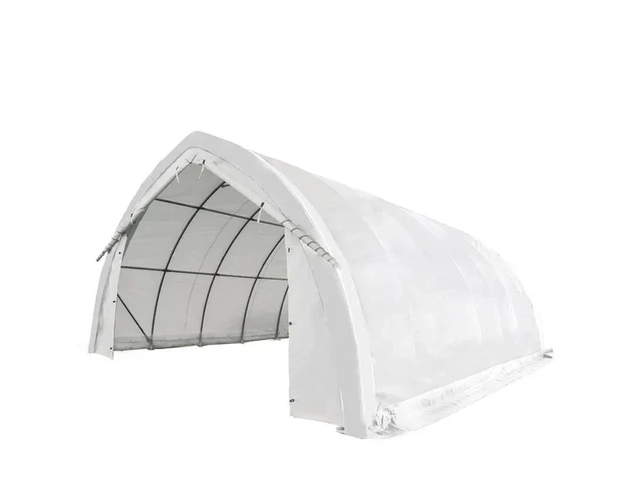
Fabric structures on Australian properties mostly go up for one of two reasons: to keep machinery out of the sun, or to hold hay dry through a wet season. Both jobs reward a shape that sheds weather cleanly, and that is what an arch does better than a straight wall.
What it gives up is headroom at the perimeter. A arch wall storage shelter of six by nine metres has usable height along its centre and a curve closing in toward both edges, which decides what can be stored where long before anything is delivered.
Why an Arch Sheds Better
Load Follows the Curve
An arch carries load in compression along its profile rather than resisting bending at a knee joint. That makes it structurally efficient and lets a lighter frame span the same width, which is the main reason these cost less than a portal-framed equivalent of identical footprint.
Nothing for Weather to Catch
Wind passing over a continuous curve separates less than it does over a square corner, so the pressure peaks across the cover are lower. Rain and any snow that does fall run off along the curve without ever finding a flat section to settle on.
The Fabric Stays in Tension
A curved frame holds the cover in tension in two directions at once, which is what stops the drumming that fatigues fabric. A machinery shelter built this way needs re-tensioning less often than a flat-roofed one.
Fewer Parts to Fail
A continuous arch has no knee joints, no haunch plates and considerably fewer bolted connections than a portal frame does. Each connection removed from the design is one less thing to work loose across a decade of wind cycles on an exposed site.
Usable Floor Against Footprint
Where the Height Goes
A machinery shelter of six by nine metres does not give six by nine metres of working space. Clear height falls away toward both long walls, so anything tall lives down the centre and the edges become walkway or low storage.
Plan Around the Taper
Shelving and bagged material suit the edges where height is limited, while a tractor or a trailer needs the middle. Working that out before ordering is what decides whether the footprint was the right one.
Comparing to a Straight Wall
A straight-walled structure of the same footprint gives more usable floor and costs more, because the steel has to resist bending where an arch does not. Neither is wrong, and the choice follows what goes inside.
Anchoring on Rural Ground
Ground type decides the anchoring method entirely.
The options are not interchangeable between surfaces at all, and a machinery shelter anchored as though it were on concrete and then erected on a soft paddock is effectively untethered when the first serious wind arrives.
What each surface needs:
- Concrete: straightforward anchors with known capacity
- Compacted gravel: long helical anchors or ballast
- Soft paddock soil: screw anchors driven well past topsoil
- Any surface: a graded pad draining away from the base
Wind on a structure this size produces uplift rather than simple lateral push, so anchors are specified by withdrawal capacity. A tractor shed standing in a wet paddock also corrodes from the bottom up where nobody inspects, which is why the pad matters as much as the anchor.
Living With It Through a Season
Ventilation Prevents the Dripping
A sealed fabric box condenses moisture on the underside of the cover every time the temperature swings, and that water lands on whatever is stored below. Ridge or gable venting costs little at build time and is awkward to retrofit.
Hay Needs Airflow More Than Cover
Hay storage under fabric wants air movement through the stack rather than a tight seal, because trapped moisture does more damage than driven rain. An open end or a raised eave serves that better than full enclosure.
Watch the Cover, Not the Calendar
Fabric is the consumable and the frame is not. Checking tension and the contact points where the cover crosses a purlin, twice in the first year and annually after, is what gets the full rated life out of it.
Where Fabric Shelters Are Going
Engineered documentation has become standard at this size rather than an option, driven by councils and insurers as much as by buyers. Heavier fabric grades and welded seams have spread down from commercial structures, and relocatable designs are increasingly chosen by operators leasing rather than owning land.
For a buyer the conclusion is that the shape decides the usable floor and the ground decides the anchoring. An implement shed and a machinery shelter can share a footprint and suit entirely different jobs, and TMG Industrial lists span, fabric weight and anchor requirements together so that judgement can be made from the listing.

