

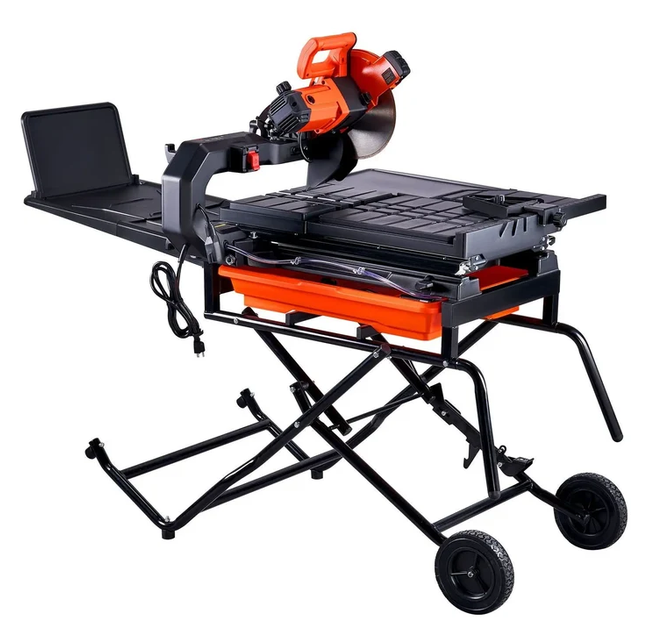
Tile setters notice it as a chipped edge on porcelain or a cut that drifts off the pencil line, and the usual response is to blame the blade. The blade is rarely the problem. A blade running slightly out of plane cuts a kerf wider than itself, loads unevenly, and chips the glaze on the way out.
That is why arbor condition matters more than blade price on a wet tile cutter. A ten inch blade amplifies a small runout at the shaft into visible movement at the rim, and everything downstream of that looks exactly like a blade fault to the person holding the tile.
Where the Wobble Comes From
Flange Faces Do the Clamping
The flanges hold the blade flat, and they only manage that if both faces are clean and undamaged. A chip of dried thinset, or a flange bent by overtightening, tilts the blade by a fraction of a degree that becomes real movement at the cutting edge.
Shaft Runout Is Harder to Fix
Bearings that have taken water, which they do on a tool working in a slurry bath, develop play that shows up as wobble under load but not when the blade is spun by hand. That is the usual explanation for a saw that cut well last season.
Checking It Takes a Minute
With the saw unplugged, a square held against the blade face at several rotational positions will show up any variation immediately. Anything visible there is worth addressing before buying another blade and concluding the manufacturer sold a bad one.
Blade Body Interacts With It
A thin continuous rim blade is quieter and cuts a narrower kerf while tolerating less runout than a thicker segmented one. That is why a worn saw often performs better with a sturdier blade than with a premium thin one.
Why the Blade Needs a Water Feed
Cooling and Flushing
Water on a wet saw cools the blade and flushes the kerf clear, and the flushing function is the one that actually affects cut quality. Slurry trapped in the cut abrades the blade body rather than the tile, and it produces heat at precisely the point where heat does the most damage.
Aim Matters More Than Volume
Water arriving on both faces of the blade at the point of entry is the target to aim for. A pump sitting in a tray full of settled slurry delivers grit straight back into the cut, which does more harm than a smaller volume of clean water cleanly placed.
Change the Water
A tray that has not been emptied carries suspended porcelain fines that act as an additional abrasive. That is a measurable cause of premature blade wear, and draining and rinsing between jobs takes two minutes.
Matching the Blade to the Tile
Material hardness drives wet saw blade selection in the same counterintuitive direction as all diamond cutting. Hard dense porcelain needs a softer bond so new diamond keeps being exposed, while soft ceramic and natural stone abrade the bond quickly and need a harder one.
Rim type follows the finish required:
- Continuous rim: slowest, cleanest edge on glazed tile
- Segmented rim: faster, more chipping
- Turbo rim: clears debris well, middle ground
- Keep a spare for the material you cut least
A tile saw and a snap-style tile cutter are complementary rather than competing. A scoring cutter handles straight full cuts in standard ceramic faster and with no water at all, while the saw does the miters, the notches and anything a scoring wheel will not break cleanly.
Cutting Wet Without Electrical Risk
The Defining Hazard
Mains electricity and standing water together define safe practice on a wet saw. A residual current device, whether built in or as a plug-in unit, is the control that matters, and it needs testing rather than assuming.
Cable Routing Is Second
A lead lying in tray water, or running where it will be walked on in a wet area, is the realistic failure rather than the saw itself. Keeping the supply above and behind the saw costs nothing at setup.
Eye Protection Despite the Water
Wet cutting suppresses most dust and still throws slurry and occasional chips, and a cut being finished by hand pressure is the moment a fragment leaves. Hearing protection applies on a long day of porcelain.
Where Tile Cutting Is Going
The direction is battery platforms at the smaller end and better water containment at the larger, with enclosed trays and recirculating filtration becoming common as silica dust rules tighten around dry cutting. Bridge saws with sliding rails have largely replaced fixed-table designs for large-format tile.
For a tile setter the conclusion is that a well-maintained saw with a mid-priced blade outperforms a worn saw with an expensive one. TMG Industrial lists blade capacity, cutting depth and water system details together, which makes it possible to judge whether a saw suits the tile being laid.

