

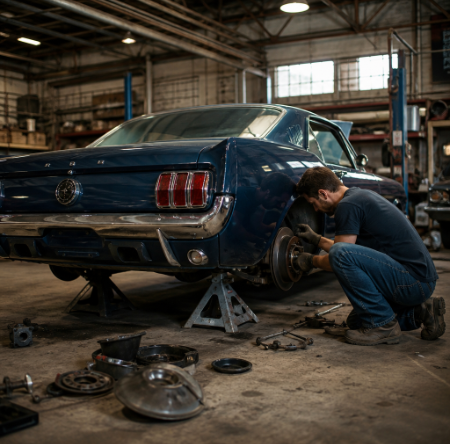
Almost every first-generation Mustang owner starts with the same fantasy: Saturday morning, cold air, a warm small-block, and forty minutes of back roads with nowhere to be. The fantasy is real and achievable. What surprises people is which version of the car actually delivers it — because a concours-correct 1966 coupe and a weekend-ready 1966 coupe are two very different machines, built for two very different owners. Understanding that difference before you spend money is the single most useful thing a prospective buyer can do.
Three Kinds of Classic Mustang, Three Kinds of Ownership
Vintage Mustangs tend to fall into three buckets, and the labels matter more than the paint color.
The survivor. Original drivetrain, original trim, honest wear. These are historically interesting and often the best value per dollar, but they drive like 1965: drum brakes that need planning, steering with a half-turn of vagueness at center, no air conditioning worth the name, and a generator or early alternator that dislikes long nights with the headlights on. Owners of good survivors usually accept that the car is a 150-mile-a-weekend proposition in fair weather.
The restored show car. Correct date-coded components, correct fasteners, correct overspray in the engine bay. Gorgeous, but every mile is a depreciation event in the eyes of a judging sheet. Plenty of these cars see fewer than 500 miles a year, and the owners are fine with that — the hobby here is the car as artifact.
The restomod. Vintage shell and proportions, modern mechanicals: fuel injection, four-wheel disc brakes, rack-and-pinion steering, a five- or six-speed gearbox, real climate control, modern seat structures and belts. This is the car most people actually describe when they say they want a classic Mustang. It starts in the rain, idles in traffic, and stops from 70 mph without drama.
The Honest Math of a Ground-Up Build
Here is where the romance meets the invoice. A rust-free Western shell is cheaper to finish than a cheap Northeast car by a wide margin, because bodywork is the one line item that expands without warning. Floor pans, torque boxes, cowl, lower quarters, trunk drop-offs — each one is labor measured in days, not hours, and labor is the dominant cost in any serious restoration. Parts for a 1965–1968 Mustang are famously available; skilled metalwork and paint are not.
A realistic sequence for a full build looks like this:
- Disassembly and documentation — photograph everything, bag and label every fastener.
- Media blasting or chemical stripping to reveal what the body filler was hiding.
- Metal repair and panel fitment, including gaps set with the doors hung and glass in.
- Paint and body, typically the longest single phase and often the most expensive.
- Chassis, suspension, brakes and drivetrain installation.
- Wiring, plumbing, glass, trim and interior.
- Shakedown: 300 to 500 miles of sorting leaks, alignment, idle quality and squeaks.
Most first-time builders underestimate stages six and seven by a factor of two. A modern harness in a 1960s body is a custom job every time, and the shakedown phase is where a car either becomes trustworthy or becomes a project someone else finishes.
Why Buying Finished Usually Beats Building
There is a well-worn conversation in the collector world about buyers who want the romance of an old car and then discover the reality of carburetor jetting, vapor lock and 1960s ergonomics. A thoughtful discussion of that gap between expectation and ownership came up in a conversation with a builder about what clients think they want from classic cars, and the lesson generalizes well beyond famous customers: the people happiest with vintage metal are the ones who bought the car that matches how they actually plan to drive.
Financially, buying finished is almost always cheaper than finishing. A completed, sorted car trades at market value; a half-done build trades at the value of its parts, minus a discount for the unknown. If you enjoy the work itself, build — it is a legitimate hobby with its own rewards. If you want the drive, buy the drive.
What to Look For in a Builder or Specialist Seller
Judging a shop is a learnable skill, and the criteria overlap with any specialty vehicle purchase. The same questions apply whether you are commissioning a vintage Mustang or evaluating what separates a serious custom golf cart builder from a reseller: who engineered the components, who stands behind them, and what happens when something needs adjusting two years later. Specifics worth asking for:
- Photographic build documentation from bare shell forward, not just finished glamour shots.
- Named component suppliers for brakes, suspension, EFI and transmission — and a reason each was chosen.
- A written warranty on the build, with clear coverage terms.
- Service capability: can they support the car after delivery, or does it become your local mechanic’s puzzle?
- Panel gap and shut-line photos. Gaps reveal metalwork quality faster than any paint finish.
- A test drive of 20 minutes minimum, including highway speed, a hard stop, and a hot restart.
Red Flags
Fresh undercoating sprayed over everything. Mismatched fastener finishes. A heater core bypassed “temporarily.” Exhaust with a fresh coat of high-temp paint. Any seller unwilling to let an independent inspector put the car on a lift.
Where a Purpose-Built Restomod Makes Sense
If the goal is a 1960s Mustang you can drive like a modern car — one that holds a lane at 75 mph, cools in traffic, and does not need a pre-drive ritual — then the market for professionally engineered reproduction and restomod Mustangs deserves a serious look. Specialists in this corner of the hobby, including builders offering turnkey classic mustangs for sale, approach the car as a complete engineering project rather than a parts-catalog assembly, which is what makes the difference between a restored body with modern bits bolted on and a vehicle designed as a coherent whole. The practical upside is that the engineering decisions, warranty exposure and shakedown miles have already been absorbed by someone else before the keys change hands.
Running Costs Nobody Mentions
Budget for the unglamorous items. Classic-car insurance with agreed value and a mileage allowance is usually modest, but it comes with storage requirements. Ethanol-blended fuel is hard on older rubber and carburetor components, so plan on fuel-system attention or a tolerant modern system. Tires age out before they wear out — six years is a reasonable replacement horizon regardless of tread. A trickle charger is mandatory. And if the car lives in a humid climate, a dehumidifier in the garage will outperform any amount of wax.
Buy the Car You’ll Actually Drive
The 1964½–1970 Mustang remains the most approachable entry into vintage American performance for good reasons: huge parts support, deep documentation, enormous community knowledge, and a shape that still stops people in parking lots. The mistake is choosing a specification by nostalgia rather than by use. Decide first how many miles a year you want, in what weather, with whom in the passenger seat. Then buy the version of the car that supports that answer, and let somebody else chase the judging sheet.

