

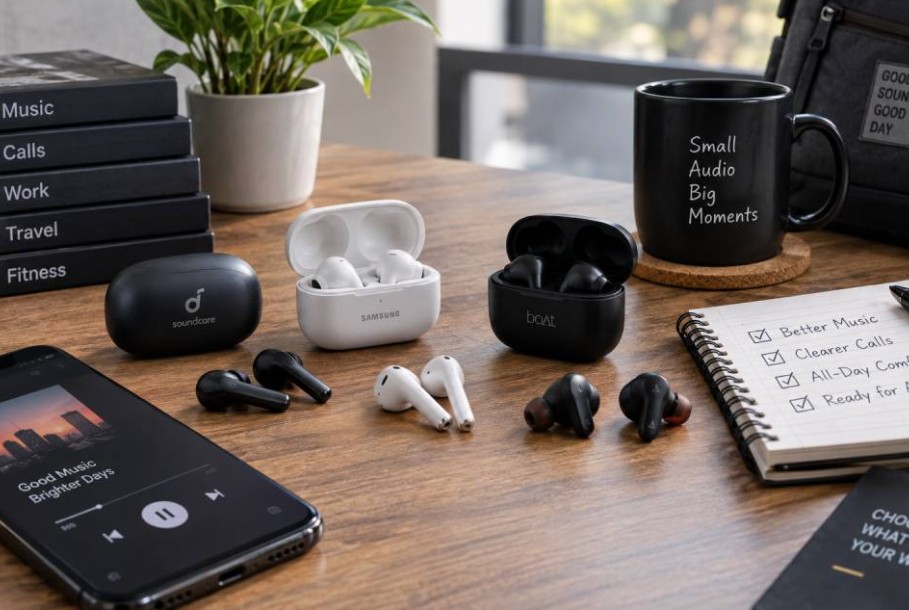
The right pair of TWS earbuds depends on how you actually use them, not on which model has the longest spec sheet. Music lovers should prioritize driver size and sound balance, while people who take calls all day need clear mics and stable connections more than deep bass.
Shopping for earbuds gets confusing fast once you start comparing driver sizes, ANC ratings, and battery claims side by side.
Before you check TWS price in bd listings, it helps to know which specs actually matter for your daily habits and which ones are just marketing noise.
This guide breaks down what TWS earbuds are, how to match them to your routine, and what to check before you spend your money.
What Does TWS Actually Mean?
TWS stands for True Wireless Stereo. Unlike neckband earphones, TWS earbuds have no cable connecting the two buds at all, so each one works as its own independent speaker.
This design is what makes them so popular for daily use. You can grab one bud for a quick call and leave the other in the case, something a wired or neckband pair simply cannot do.
The tradeoff is that each earbud needs its own battery and chip, which is why battery life and connection stability vary so much between cheap and premium models.
Match Your Earbuds To How You Actually Use Them
Different daily habits call for different priorities. Here is a quick breakdown of what to focus on based on your main use case.
| Use Case | Priority Feature | Secondary Feature | Skip If Not Needed |
| Music Listening | Driver size and sound balance | Battery life | ANC |
| Calls and Work | Clear microphones (ENC) | Bluetooth stability | Deep bass tuning |
| Everyday Commuting | Comfort and fit | Water resistance | High-end codecs |
| Gaming | Low latency mode | Stable Bluetooth range | Long battery per charge |
For Music Listeners
If you mostly listen to music, focus on driver size and sound signature over anything else. A 10mm to 13mm driver generally delivers fuller bass and clearer vocals, and codec support like aptX or LDAC on Android makes a real difference if your source files are high quality.
For Calls and Work
If your earbuds spend most of the day on calls, prioritize microphone count and ENC support over sound quality. Multiple mics working with noise isolation keep your voice clear even in a busy office or a loud street, which matters far more than bass depth during a client call.
For Everyday Commuting and Multitasking
For daily commuting and errands, comfort and a secure fit matter more than any single spec. Look for lightweight buds under 5 grams each and a box that includes multiple ear tip sizes, since a poor seal weakens both bass and any noise cancellation you paid for.
ANC Or ENC: Know The Difference Before You Buy
ANC and ENC solve different problems, and mixing them up is one of the most common buying mistakes. ANC blocks ambient noise while you listen to music, while ENC cleans up background noise specifically during calls.
Suppose you commute on a noisy bus every morning. ANC earbuds will quiet that rumble so your music sounds clearer. Suppose instead you take client calls from a busy office.
ENC earbuds filter out that background chatter so the other person hears you clearly, even without active noise cancellation turned on.
Many mid-range and premium earbuds now include both, but budget models often only support one or neither, so check this specifically before you buy.
Battery Life And Charging Case: What Numbers Actually Mean
A “30 hour battery” claim almost always includes multiple recharges from the case, not one continuous charge. The earbuds themselves typically last 4 to 7 hours per charge, with the case adding several more full recharges on top of that.
For daily use, look for at least 5 hours of playback per charge and a case that can recharge the buds three to five times before it needs plugging in itself.
Fast charging is a genuine convenience feature, since a 10 to 15-minute top-up that buys you an hour of playback can save a rushed morning.
Fit And Comfort Matter More Than Spec Sheets
Two earbuds with identical specs can feel completely different in your ears, and a poor fit undermines everything else you paid for. If the seal is loose, bass response drops, outside noise leaks in, and any ANC feature has less ambient sound to work with in the first place.
Check that the box includes at least three ear tip sizes, and look for models with ear wings or fins if you plan to exercise or move around while wearing them.
Weight matters too, since anything noticeably heavy starts to feel uncomfortable after an hour or two of continuous wear.
Quick Checklist Before You Buy TWS Earbuds
Use this short checklist to confirm you are buying the right pair for your actual routine, not just the one with the flashiest listing.
- Match the feature to your main use case. Prioritize drivers for music, mics for calls, and comfort for daily commuting, based on what you do most often.
- Confirm ANC or ENC support separately. Do not assume one feature means you automatically get the other.
- Check battery life per charge, not just total. A single-charge figure of 4 to 7 hours is a realistic daily baseline.
- Look for at least three ear tip sizes in the box. This is the easiest way to guarantee a proper seal.
- Buy from an authorized retailer with a warranty. This protects you against grey-market units, which are common in this category.
What To Buy Based On How You Listen
Choosing TWS earbuds becomes simple once you separate your actual habits from marketing claims. Music listeners should chase driver quality, callers should chase clear mics and ENC, and daily commuters should chase comfort and fit above everything else.
Before you commit to a purchase, confirm your priority feature is genuinely present, not just implied by a long spec list.
A pair that matches your real routine will always outperform one chosen for its highest number on paper.

