

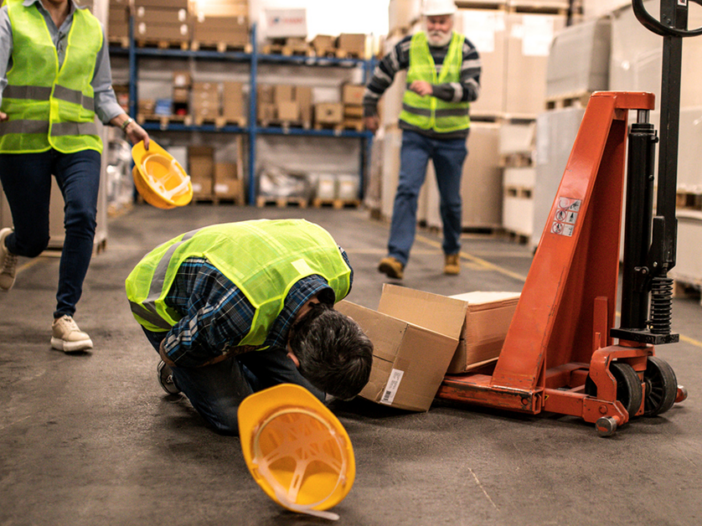
Warehouse work is physical by nature. Employees lift boxes, move pallets, reach overhead, bend repeatedly, walk long distances, and work around forklifts, carts, conveyors, and other moving equipment. Even when no single task seems especially dangerous, repeating the same movements throughout a shift puts steady strain on the body.
Some injuries happen in seconds. Others build slowly over weeks or months. Both types of injuries often raise workers’ compensation questions, and https://lacaccidentpros.org may become relevant when pain affects a worker’s ability to keep doing the same job or when a claim becomes difficult to resolve.
Heavy Lifting Does More Than Strain the Back
Back injuries are strongly associated with warehouse work, but lifting also affects the shoulders, knees, elbows, wrists, and neck.
A worker does not have to lift an unusually heavy object to get hurt. Problems often start when moderate loads are handled repeatedly, lifted from awkward positions, or moved while the worker is twisting. Reaching into deep containers, lifting from floor level, or placing boxes on high shelving puts the body in positions where muscles and joints absorb extra stress.
Fatigue also changes how people lift. A motion that feels easy early in a shift becomes harder after several hours of physical work. Grip strength weakens, posture changes, and workers sometimes rush to stay on pace.
A single awkward lift could result in a sudden strain, while repeated lifting often leads to soreness that gradually becomes harder to ignore.
Repetition Creates Injuries Without a Single Accident
Not every workplace injury has an obvious moment attached to it.
Warehouse employees often repeat the same motions hundreds of times during a shift. Scanning products, gripping packages, taping boxes, loading shelves, sorting items, and reaching across workstations all place stress on the same muscles and tendons.
At first, symptoms often seem minor. A worker notices tingling in a hand, soreness in one shoulder, stiffness in the lower back, or pain that fades after resting. Over time, the discomfort lasts longer and starts appearing earlier in the workday.
These injuries sometimes become difficult to explain because there is no dramatic fall or collision. The job itself, performed repeatedly over time, is what causes the physical strain.
Fun fact: Repetitive strain injuries were recognized long before computers became common in offices. Workers performing repeated hand and arm movements in factories and other manual jobs were dealing with similar problems generations ago.
Moving Equipment Adds Another Layer of Risk
Forklifts, pallet jacks, carts, and other equipment keep warehouse operations moving, but they also create hazards for people working nearby.
A worker walking through an aisle could be struck by equipment, pinned between a vehicle and shelving, or injured when a load shifts unexpectedly. Even smaller equipment creates problems. A heavy manual pallet jack rolling over a foot or colliding with a worker’s leg can cause a serious injury.
Poor visibility makes these incidents more likely. Tall loads block sightlines, crowded aisles reduce room to move, and noise sometimes prevents workers from hearing equipment approaching.
Injuries also happen while operating the equipment itself. Repeated climbing into vehicles, prolonged sitting, constant steering, vibration, and frequent twisting to check surroundings all put strain on the body during long shifts.
Reporting Symptoms Early Creates a Clearer Record
Workers sometimes wait before reporting an injury because they expect soreness to disappear. That delay becomes more common with repetitive injuries, where symptoms develop gradually rather than after one obvious event.
Waiting creates another problem: the longer the gap between the first symptoms and the report, the harder it becomes to document how the injury developed.
Written reports, medical records, work schedules, job descriptions, witness accounts, and records of previous complaints all help establish what happened. With repetitive injuries, details about daily duties and how often certain movements were performed are especially useful.
Workers’ Compensation Lawyers Often Step In When Claims Become Complicated
Many warehouse injuries involve straightforward medical treatment, but others turn into disputes over how the injury happened, whether the job caused it, or how much work the employee is still able to perform.
Workers’ compensation lawyers help injured employees understand the claims process, review medical and employment records, respond to disputed claims, and address problems involving treatment or benefits. Their involvement is especially useful when an injury developed gradually or when an employer or insurer questions the connection between the worker’s duties and the medical condition. Readers who want to see where nearby assistance is available can find the relevant location details below:
Warehouse injuries do not always begin with a dramatic accident. Sometimes the first warning is simply pain that keeps returning at the end of every shift. Once that pain starts changing how someone lifts, walks, sleeps, or works, it deserves to be treated as more than ordinary job fatigue.

