

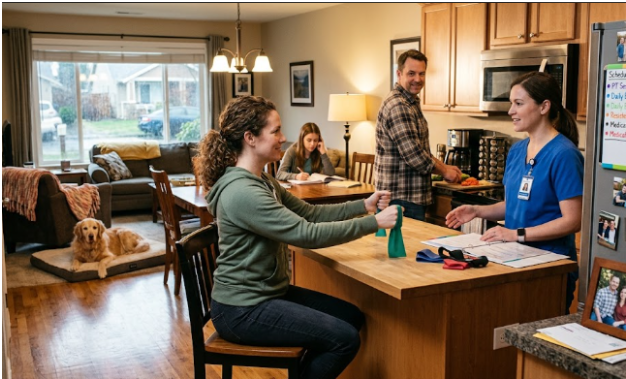
Outpatient treatment asks something of a person that inpatient care doesn’t. It asks them to keep living their actual life, sleeping in the same bed, sitting at the same kitchen table, navigating the same relationships, while also doing the work of recovery. That’s a real advantage in a lot of ways, since it builds skills directly in the environment where they’ll actually be used. It’s also exactly why home life can’t be treated as a background detail separate from treatment itself. When a program accounts for what’s actually happening at home, outpatient care tends to work significantly better than when it treats the person in isolation from their surroundings.
Why Environment Shapes Outcomes So Directly
Someone in an intensive outpatient program is only in a structured, supportive setting for a few hours, a few days a week. The rest of the time, they’re back in an environment that either supports recovery or quietly works against it. If that home environment includes ongoing conflict, easy access to substances, unsupportive family dynamics, or simply a household that hasn’t adjusted its own routines around someone’s recovery, the work done during actual treatment hours can get undone fairly quickly in between sessions.
This is part of why the same clinical presentation can lead to very different outcomes depending entirely on what’s waiting for someone at home. A well designed program doesn’t just treat the individual. It asks direct questions about that home environment and builds a plan that accounts for it realistically, rather than assuming the same generic approach works regardless of someone’s living situation.
What “Including Home Life in the Plan” Actually Looks Like
This isn’t an abstract idea. It shows up in specific, practical ways. Family therapy sessions, even occasional ones, that help household members understand what recovery actually requires and how to support it without either enabling old patterns or creating new conflict. Direct conversations about specific household triggers, whether that’s a family member who still drinks around the house, financial stress that’s contributing to tension, or a living situation that puts someone in regular contact with people connected to previous substance use.
It also includes practical coordination around scheduling and responsibilities. Someone attending sessions several evenings a week needs a home environment that can actually accommodate that commitment, whether that means coordinating childcare, adjusting household expectations temporarily, or simply having household members understand why attendance matters enough to protect it from getting deprioritized during a busy week.
Why This Matters Even More With Co-Occurring Conditions
When someone is managing a co-occurring condition, home environment plays an even larger role. Someone dealing with dual diagnosis anxiety often has specific home-based triggers tied to their anxiety, whether that’s a particular relationship dynamic, an overwhelming household responsibility, or simply a lack of quiet, low-stimulation space to decompress after a difficult day. A treatment plan that addresses the substance use and the anxiety clinically, without ever addressing what’s actually happening in the person’s living situation, misses a significant piece of what’s driving both conditions day to day.
This is a core reason dual diagnosis treatment works best when it extends into practical, home-focused planning rather than staying confined to session-based therapy alone. Coping strategies developed in a session need an actual chance to be practiced and reinforced in the specific environment where triggers show up, which is almost always at home rather than in a treatment setting.
Family Involvement Changes the Trajectory
Family members, when included appropriately, can become one of the strongest assets in outpatient treatment rather than an afterthought. This doesn’t mean every family member needs to attend every session, but even limited, well-structured family involvement, education about the recovery process, guidance on how to respond during difficult moments, clarity on what genuinely helps versus what unintentionally enables old patterns, tends to improve outcomes measurably compared to treatment that keeps family entirely at arm’s length.
For teens specifically, this matters enormously. A teen intensive outpatient program that doesn’t actively involve parents or guardians in the treatment process is missing one of the most influential factors in whether a teenager’s recovery actually holds, since teens generally have far less control over their home environment than adults do and rely heavily on the adults around them to reinforce what treatment is trying to build.
Access to the Right Kind of Program Varies by Region
Not every outpatient program is built with this level of home and family integration in mind, and finding one that is can depend partly on location. Someone searching for an intensive outpatient program San Diego families can access with strong family programming may find a different set of options than someone exploring outpatient treatment in Sacramento or researching Fort Lee addiction treatment. Regional program models differ, and it’s worth asking directly whether family involvement and home environment planning are built into a specific program’s structure, rather than assuming every outpatient option handles this the same way.
Families researching addiction treatment programs Illinois offers, or comparing options for outpatient mental health treatment NJ residents can access, benefit from asking this question early in the process, since the answer significantly affects how well treatment translates into daily life once formal sessions end for the day or week.
Questions Worth Asking Before Choosing a Program
A few direct questions can reveal whether a specific outpatient program actually incorporates home life into its planning, rather than treating it as separate from clinical care. Does the program offer family therapy sessions or family education components, and how are they structured? Does the intake process ask specific questions about home environment, household relationships, and daily living conditions, or does it focus exclusively on substance use history? Is there a plan for addressing specific home-based triggers directly, rather than only discussing coping strategies in the abstract? And for co-occurring conditions specifically, does the program coordinate care in a way that accounts for how anxiety or other symptoms actually show up at home, not just during scheduled sessions.
What This Means for Long Term Recovery
Addiction recovery doesn’t happen in a vacuum, and outpatient treatment in particular depends heavily on what happens during all the hours that aren’t spent in a session. A program that genuinely incorporates home life into its planning, through family involvement, environment specific trigger planning, and practical scheduling support, tends to produce more durable outcomes than one that treats the person as separate from their surroundings. This is especially true for anyone managing a co-occurring condition, where home environment and daily stressors are often directly intertwined with symptom severity.
The Bottom Line
Outpatient treatment offers real advantages specifically because it happens alongside real life rather than apart from it, but that advantage only holds up when the treatment plan actually accounts for what real life looks like for that specific person. A reputable addiction treatment center builds this consideration into intake and ongoing planning rather than treating home environment as incidental. Whether someone is managing straightforward substance use or something more layered like dual diagnosis anxiety, treatment that takes the whole picture seriously, including the household someone returns to every single day, gives outpatient care a genuinely better shot at working.

