

Somewhere between “I own a lot of black” and “I have a corset collection” is a wide, comfortable middle ground that a lot of people want to live in and don’t quite know how to enter. They like the darker aesthetic. They don’t want to commit to a subculture with a dress code. They’re worried the first step is a trench coat and eyeliner they can’t apply.
The first step is a lot smaller than that. A goth-adjacent wardrobe is built from ordinary garments in a specific palette with a few deliberate details, and most people already own a third of it. Here’s the starting point, piece by piece, with the mistakes that make beginners look like they’re in costume.
What does “goth-adjacent” actually mean?
It means borrowing the mood without adopting the uniform. Dark palette, some Victorian or romantic silhouettes, an interest in the macabre, a bit of drama in the details. It doesn’t mean corsets, platform boots to the knee, or a full face every day. Those are wonderful; they’re also a different commitment.
Think of it as a spectrum. On one end, a plain black turtleneck and dark jeans. On the other, full trad goth. Goth-adjacent lives about a third of the way along, where a stranger would say “they dress kind of dark” rather than “they’re a goth.”
The palette
Black is the base, but all-black every day reads flat and, honestly, a bit like a uniform. The pieces that make the look interesting are the secondary colors:
- Oxblood and deep burgundy
- Forest and bottle green
- Charcoal and washed black (faded, slightly grey black)
- Cream and bone, used sparingly as contrast
- Silver, never gold, for metals
A rule that helps beginners: black plus one. One secondary color per outfit. Black and oxblood. Black and cream. Not all three.
The eight pieces to start with
You don’t need a closet overhaul. These eight cover most situations:
- Black fitted turtleneck. Works alone, under everything, in every season but summer.
- Black straight-leg denim or trousers. Not skinny; straight reads more current.
- A long black skirt or wide-leg trousers. Movement is a big part of the aesthetic.
- Black leather-look ankle boots. Combat or Chelsea, your call.
- One patterned dark cardigan. More on this below.
- A black or dark green button-up. Tucked, untucked, or worn open over a tank.
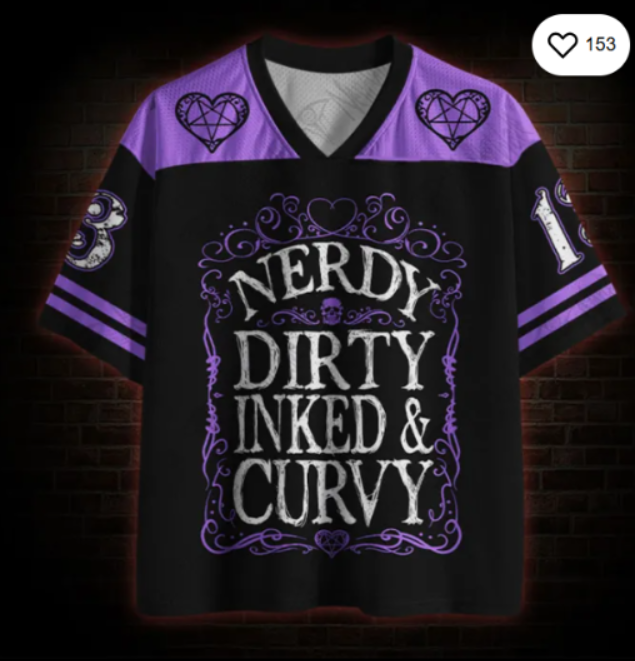
- A washed black graphic tee with a design you’d defend, and for summer a breathable nerdy mesh jersey in a dark all-over print does the same job when a tee is too plain and a knit too warm.
- A long dark coat. Wool if you can; the silhouette matters more than the fabric.
Add jewelry and you’re done. Everything else is expansion.
Why is the cardigan the key piece?
Because it does the work of a costume without being one. A plain black cardigan is fine and safe. A dark cardigan with a knitted-in pattern of moths, bats, skeletons, occult symbols, or black cats is the single garment that most efficiently signals the aesthetic while staying wearable everywhere.
The nerdy cardigan sweaters that have appeared from specialist brands in the last few years are almost perfectly designed for the goth-adjacent beginner: they carry the mood in the pattern, so the rest of the outfit can be a plain turtleneck and jeans. Nothing about a knit says “costume.” A sweater with skeletons on it is still, to the average onlooker, a sweater. That’s the point.
Wear it open over a tee on weekends, buttoned as a top with a skirt, or under the long coat. One knit, three registers.
Jewelry and details
This is where beginners overdo it. The goth-adjacent version is restrained:
- One or two silver rings
- A single pendant, small, with a shape that means something (a moon, a bat, a key, a coffin)
- Simple hoops or small studs
Skip spiked collars, chains in multiples, and anything that jangles. Those belong further along the spectrum.
Black nail polish is low-commitment and does more than you’d expect. So does a dark lip in wine rather than true black, if lipstick’s your thing.
Common mistakes
Everything at once. The first outfit shouldn’t include the coat, the patterned knit, the graphic tee, the pendant, the rings, and the boots. Two statement elements maximum. Three is costume.
Cheap black. Fast-fashion black fades to a sad grey-brown within a season and looks it. Spend a little more on the pieces you’ll wear most, or thrift older black garments that were dyed properly.
Tightness as a default. Skinny everything was the 2010s. The current version of the aesthetic favors flow: long skirts, wide trousers, oversized knits over fitted tops.
Ignoring texture. All-black in the same fabric is a void. Mix knit, denim, leather-look, and something soft like velvet. The eye needs somewhere to land.
A first week of outfits
Monday: turtleneck, patterned cardigan open, straight black denim, boots.
Tuesday: dark green button-up, black trousers, boots, one ring.
Wednesday: washed graphic tee, plain black cardigan, denim, boots, pendant.
Thursday: turtleneck tucked into long black skirt, cardigan buttoned, boots.
Friday: button-up open over black tank, wide-leg trousers, coat, rings.
Nobody would call any of those a costume. All of them are unmistakably the aesthetic.
How do you go further later?
Once the basics feel like yours, expand along the axis that appeals most. Romantic: velvet, lace details, longer skirts. Industrial: heavier boots, cargo trousers, harder silver. Witchy: tiered skirts, wide-brim hat, layered thin pendants. Each direction starts from the same eight pieces.
The single best first purchase
If you buy one thing, make it the patterned cardigan. It transforms clothes you already own, it works in more contexts than any other piece on the list, and it’s the garment most likely to make you feel like the aesthetic is yours rather than something you’re trying on. Start there. The coat can wait.

