

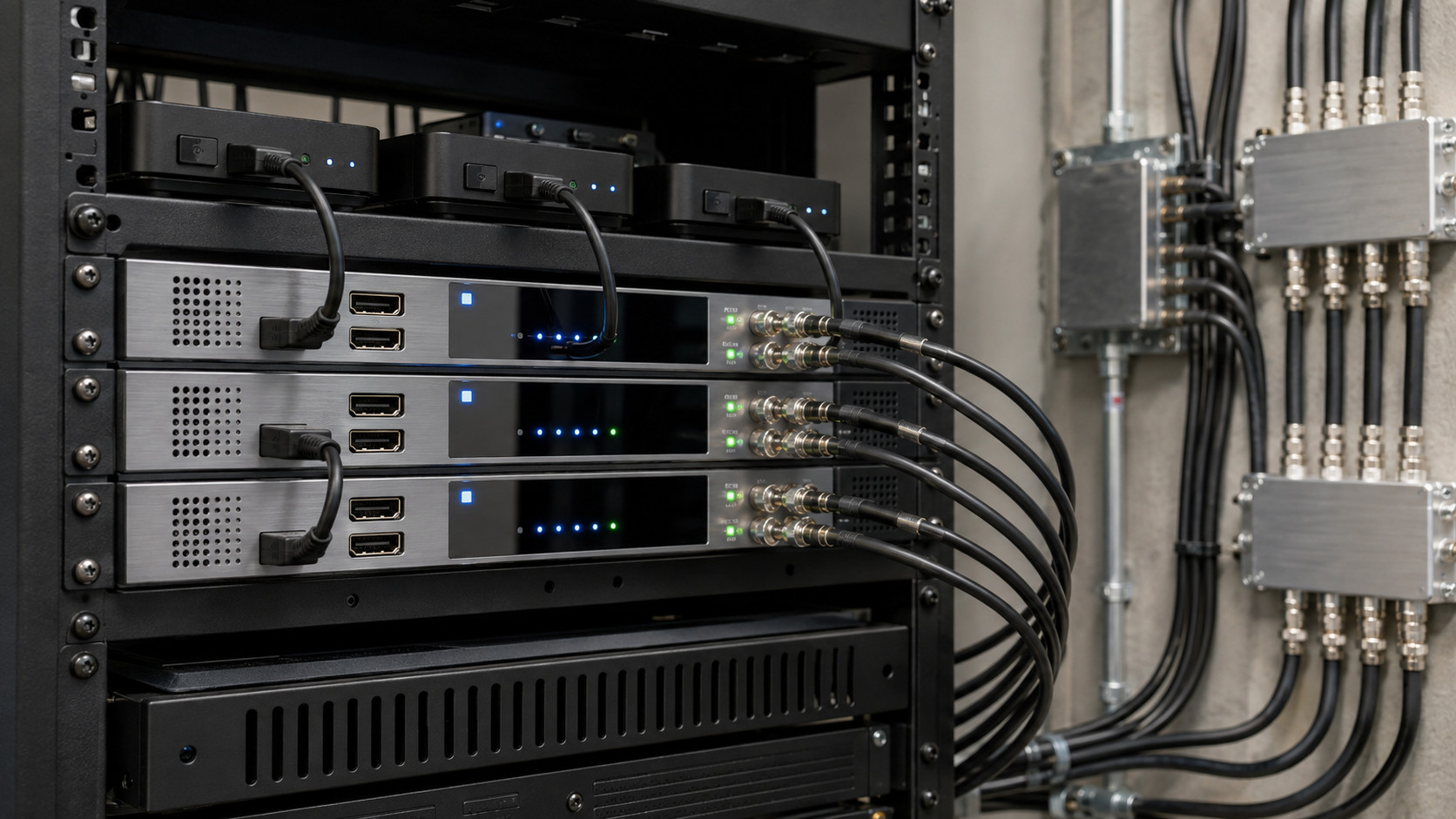
Many hotels, schools, hospitals, apartment buildings, and commercial facilities already have extensive coaxial cabling installed for television distribution. Replacing this infrastructure with new data cabling may be expensive and disruptive. HDMI-to-QAM modulation offers a practical alternative by converting HDMI video sources into digital television channels that can travel through the existing coaxial network.
This approach allows standard televisions to receive locally generated content through their built-in digital tuners, often without requiring a separate set-top box at every display.
How HDMI-to-QAM Distribution Works
An HDMI-to-QAM modulator accepts video and audio from one or more HDMI sources. It encodes the content, packages it into an MPEG transport stream, and modulates the service onto a digital RF channel.
The resulting QAM signal can be combined with other locally generated channels or an existing CATV feed. It then travels through coaxial cables, splitters, taps, and amplifiers to connected televisions.
Each television performs a digital channel scan and stores the new service as part of its normal channel lineup. From the viewer’s perspective, the HDMI source behaves like another television channel.
Common HDMI Sources
A wide range of devices can supply content to the modulator, including:
- Satellite and cable receivers.
- Digital signage players.
- Media servers.
- Security camera systems.
- Computers and presentation systems.
- Blu-ray players.
- Campus or hotel information channels.
- Live event production equipment.
The source should provide a stable HDMI signal at a resolution and frame rate supported by the encoder. Consumer devices may change their output format after restarting or reconnecting, so fixed-output settings are preferable in professional installations.
Encoding and Compression
Before modulation, uncompressed HDMI video must be encoded. H.264 is commonly used because it provides good image quality and broad receiver compatibility. Some newer systems support H.265, although not every television can decode it.
The selected bit rate affects both image quality and the number of programs that can fit within one QAM channel. Fast-moving sports and detailed video generally require more bandwidth than static information screens.
Audio format must also be considered. MPEG audio and Dolby Digital may be supported, but compatibility varies by television model and region. Testing the complete receiver population is important before choosing the final encoding configuration.
Building the QAM Channel Lineup
A QAM modulator assigns each program to a physical RF frequency and provides the service information required by digital televisions. Depending on the equipment, multiple encoded programs may be combined within one QAM carrier.
Every output carrier must occupy an unused frequency. If the local channels are combined with an existing CATV service, engineers should document the complete spectrum before selecting new frequencies.
The configuration may include:
- RF output frequency.
- QAM constellation, such as QAM 64 or QAM 256.
- Symbol rate.
- Program number.
- Virtual channel mapping.
- Transport stream identifier.
- Program name and service information.
Consistent configuration helps televisions identify and organize channels correctly. However, channel-display behavior can differ between manufacturers, especially when virtual channel mapping is used.
Combining Local and Existing Channels
The modulator output is typically connected to an RF combiner together with the existing television feed. Proper isolation between input ports prevents signals from one source from entering another device.
The inserted QAM carrier should be adjusted to a level comparable with adjacent digital channels. A signal that is too low may fail at distant outlets, while an excessively strong signal can overload amplifiers or television tuners.
Adding carriers also increases total composite RF power. The complete channel lineup must remain within the operating range of every downstream amplifier and active distribution component.
Coaxial Network Requirements
The coaxial plant must support the selected frequencies and maintain a 75-ohm impedance throughout the system. Cables, connectors, splitters, taps, wall outlets, and amplifiers should all be rated for the required bandwidth.
Older components may introduce excessive loss at higher frequencies. Poorly installed connectors can also create reflections, interference, and intermittent reception.
Engineers should calculate the distribution loss from the combiner output to the most distant television. The design must account for cable attenuation, splitter loss, tap values, outlet loss, and amplifier gain.
Signal Quality and Testing
Digital television performance cannot be evaluated by RF level alone. A strong signal may still fail if it contains excessive noise or distortion.
Important measurements include:
- RF carrier level.
- Modulation error ratio.
- Pre- and post-correction bit error rate.
- Frequency accuracy.
- Adjacent-channel performance.
- Signal level at representative outlets.
Testing should be performed at the modulator output, after the combiner, following major amplifiers, and at both nearby and distant television outlets.
Each important television model should also be tested for channel scanning, video decoding, audio compatibility, and channel-number presentation.
Content Protection Considerations
Some HDMI sources use High-bandwidth Digital Content Protection. A professional installation must respect all content licenses, distribution agreements, and copyright requirements.
Not every modulator can accept protected HDMI output, and technical methods intended to bypass protection should not be used. Operators should select authorized sources and equipment designed for the intended commercial or institutional application.
Benefits of HDMI-to-QAM Distribution
This architecture offers several practical advantages:
- Reuses existing coaxial infrastructure.
- Delivers one source to many televisions.
- Reduces the need for set-top boxes at individual displays.
- Supports centralized content management.
- Integrates local channels with an existing lineup.
- Works with many standard digital television tuners.
- Simplifies distribution across large buildings.
- Provides predictable, low-latency viewing.

