

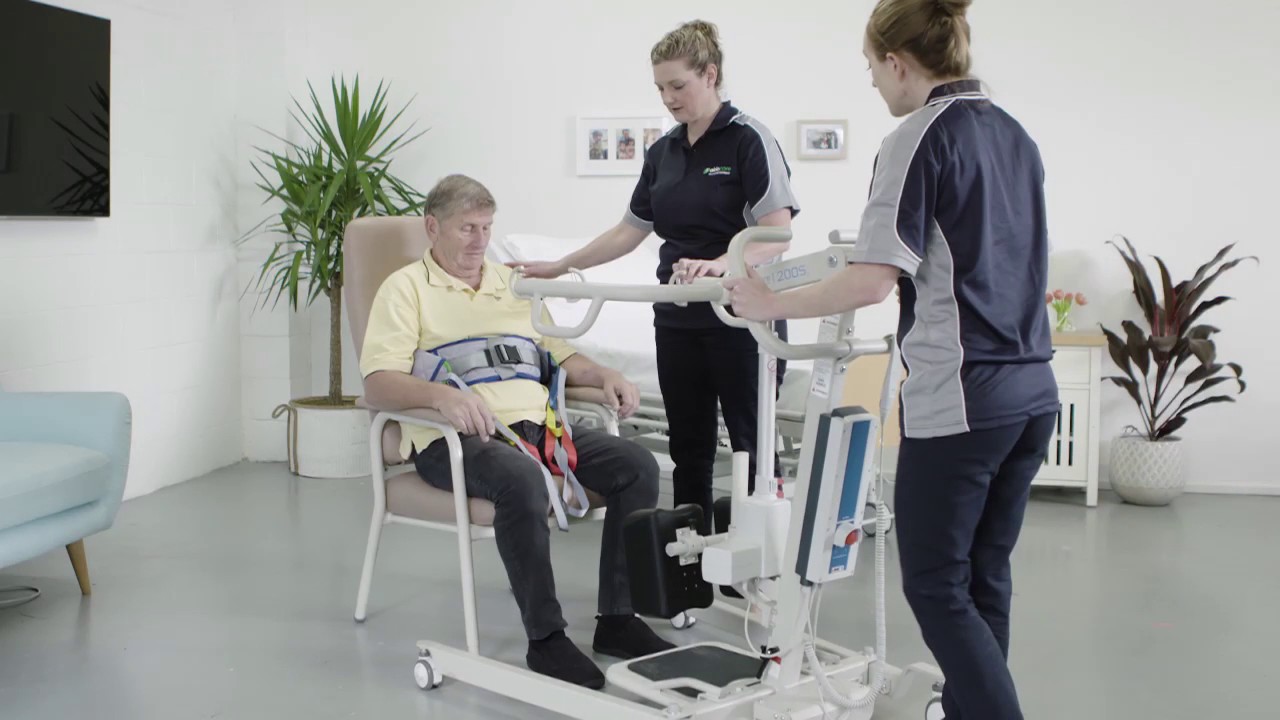
Preserving mobility, muscle strength, and independence is the focus of rehabilitation, aged and home care. For those who can maintain partial weight-bearing, yet cannot rise unassisted, daily routines can be overwhelming. Traditional manual transfers from seated to standing position place a great physical demand on the caregiver and may leave the care recipient feeling anxious and unstable.
The use of appropriate assistive technology promotes, as far as possible, independent and active participation in an activity of daily living. The use of a stand-up lifter, or modern standing hoist, allows care facilities and home caregivers to provide transfers in a more dignified and safe manner while protecting the caregiver from the physical demands of the transfer.
How Does a Standing Hoist Work?
A standing hoist is a type of lifter that helps people with partial weight-bearing capability and good head and trunk control to rise from a seated to a standing position by using their own muscles in a manner similar to the normal sit to stand action. Other types of lifters completely take off a person from the surface.
The stand-up lifter has an adjustable base, a footplate, knee and lower leg supports, and ergonomic grips. It is equipped with a lifting arm and a special type of stand-up sling that is placed around the user’s lower back. The hoist then pulls the user up and forward in a standing position.
Active Standing Lifts Benefits
- Functional Independence Weight Bearing
An active lift is a hydraulic or mechanical device that provides physical assistance with standing but does not transport the individual to a standing position like a passive lift. An active lift promotes individual engagement of the leg and core muscle groups. An active lift does not replace the patient’s ability to physically lift themselves to a standing position. Rather, it supports the individual’s physical capabilities to do so. An individual’s ability to bear their own weight is critical in maintaining and improving their bone density and circulatory health, as well as reducing the risk of bowel impaction and urinary retention.
- Protection from Caregiver Musculoskeletal Injury
There are many risks associated with assisting an individual with limited mobility to a standing position from a seated position. These risks include straining the caregiver’s back and arms and putting a strain on the caregiver’s shoulders by twisting the arms in an awkward position. A standing mechanical lift eliminates this risk, because the machinery does the heavy lifting and the caregiver only has to guide the individual to the standing position using hand controls.
- Toileting and Daily Hygiene
Transferring a person to the toilet or for a bath or shower with a standing mechanical lift is often easier and more convenient, as the sling supports are located around the back and under the arms. Therefore, the lower extremities of the individual being transferred are not obstructed. Also, standing mechanical lifts are easy to use for personal hygiene transfers, since the sling stays around the mid back and under the arms.
- Contoured Knee Pads and Footplates: The pads feature adjustable heights to create a secure fit and help prevent knee collapse during the rising motion. Footplates can be removed to allow for the participation of the user in active walking rehab exercises.
- Ergonomic Sling Designs: The slings are made of a thick foam material and provide lumbar support to prevent “sliding up” under the arm and to distribute the support evenly.
Compact Maneuverability: The castors allow these stand aids to travel easily through small spaces like doorways and bathrooms.
Active stand-up transfer aids have a multitude of uses in both health care and residential care settings.
- Aged Care & Assisted Living: Helps seniors with mobility to maintain their mobility for longer by reinforcing the correct movement patterns.
- Rehab Centers: The stand aids are very useful during the rehab process to strengthen leg and balancing muscles by helping the patient to stand with the support and using it for balance.
- Home Healthcare: Family members and home health care workers in the residence can use the active transfer aids to provide support and reinforce the correct movement patterns for patient transfers.
Best Practices for Safe Operation
To use an active transfer aid safely and comfortably, keep the following in mind:
- Verify Weight-Bearing Capacity: Users should have the ability to bear weight through both legs and basic control of their trunk in order to utilize an active hoist. If the user is unable to assist with weight bearing, a full body ceiling or floor hoist should be used instead.
- Choose the Appropriate Sling Size: The standing sling should be snug to the waist to avoid slipping during the transfer.
- Secure Furniture: Place the user’s feet evenly on the footplate and secure the shin pads to the user’s lower legs prior to initiating the lift.
- Perform Preventative Maintenance: Periodically charge the battery, inspect the slings for fraying and wear, and maintain the device to ensure peak performance.
Conclusion
Using an active standing hoist, not only empowers users to take part in more socially and mentally stimulating activities, it aids in the protection of the caregivers’ physical wellbeing. With an increasing elderly population who are becoming less mobile, protecting caregivers and allowing users to engage in more physical activities is becoming increasingly more important.

