

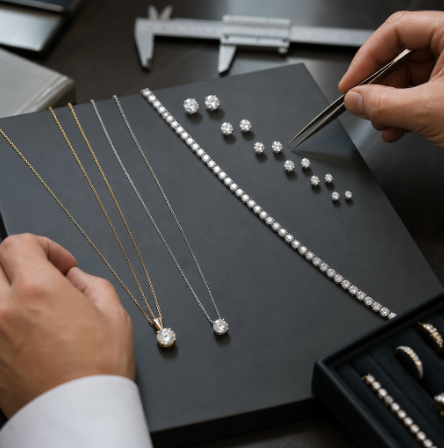
Most disappointment with fine jewelry is not about quality. It is about scale. A beautifully cut diamond stud can look lost on a wide earlobe, a cross pendant can sit awkwardly in the hollow of the collarbone instead of below it, and a tennis bracelet can spin so that the clasp faces up all day. None of those are flaws in the piece — they are sizing decisions made from a photograph instead of a measurement. Here is how to get the numbers right before you buy.
Carat weight tells you less than millimeters
Carat is a measure of weight, not width. Two round diamonds of the same carat weight can differ in diameter depending on how deep the stone is cut; a deep stone hides weight below the girdle, where nobody sees it. For everyday choices it helps to know the rough visual ladder for round brilliants: a quarter-carat round sits near 4 mm across, half a carat lands around 5 mm, and a one-carat round is in the 6.4–6.5 mm range. That means doubling the carat weight does not double the apparent size — it adds roughly a millimeter and a half of face-up width.
The practical takeaway: when you compare two pieces, compare the millimeter spread first and the weight second. If a listing gives you both, you have enough information to predict how the piece will actually read from a conversational distance of a few feet.
Stud earrings: match the stone to the lobe, not to a trend
Take a ruler to a mirror and measure the height of your earlobe from the piercing to the bottom edge. Small lobes under about 12 mm look balanced with studs in the 3–5 mm range; larger lobes carry 6 mm and up comfortably without the stone appearing to sink. If your piercing sits low on the lobe, keep the stone smaller or choose a setting with a flat back so it does not tip forward.
Solitaire, cluster or motif
A solitaire round is the most literal expression of size: all the sparkle sits in one footprint. Clusters spread several smaller stones across a wider surface, so they often read larger than a solitaire of equal total weight — useful if you want presence without a single large stone. Motif studs such as hearts, clovers, or squares with gemstone accents behave differently again: the outline does the work, and the eye measures the whole shape rather than the center stone. If you wear your hair pulled back often, the outline matters more than you think.
Backs and comfort
Anything above roughly 1 carat per ear benefits from a screw-back or a larger friction back with a stabilizing disc. Weight pulls the stone forward over a long day, and the fix is mechanical, not decorative.
Pendants and cross necklaces: the chain is half the design
Chain length is the single most under-considered measurement in fine jewelry. As a general map on an average adult neck: 16 inches sits at the base of the throat, 18 inches rests just below the collarbone, 20 inches lands a couple of inches lower on the chest, and 22 inches falls near the top of the sternum. Necks vary, so measure with a soft tape and add an inch or two if your neck circumference is above average.
Then match the length to the piece. A small solitaire pendant reads best at 16–18 inches, where it stays in the visual frame of the face. A cross pendant with vertical length needs room to hang clear of a neckline, which usually means 18–20 inches; at 16 inches the lower arm of the cross can disappear into a crewneck. If you layer, separate chains by at least two inches so the pendants do not collide and tangle. For pieces worn daily, the bail — the loop the chain passes through — deserves a look too: a snug bail keeps a pendant facing forward, while an oversized one lets it swing sideways.
Tennis bracelets: fit decides whether you wear it
Wrap a tape measure snugly around your wrist bone, then add about half an inch for a close fit or three-quarters of an inch for a bracelet that moves a little. Tennis bracelets are a line of linked settings, so they behave less like a bangle and more like a flexible strap: too loose and the heavier stone side rotates downward and the clasp rides on top; too tight and the links press into skin when you type or drive.
Two details repay attention. First, the link width: a narrow line of small stones is a quiet everyday piece, while wider settings read as a statement and take more clearance under a shirt cuff. Second, the safety mechanism — a box clasp with a figure-eight or tongue-in-slot safety is what keeps a continuous line of diamonds on your wrist and not on the sidewalk.
Metal, color and the fancy-color question
White gold in 14K and 18K both work for diamond settings, with a trade-off worth knowing: 18K carries more gold and a slightly richer tone, while 14K is harder and holds up well to the knocks of daily wear. Colored accents change perceived size as well as mood — emerald, ruby and sapphire next to white diamonds create contrast that makes a small cluster look busier and bigger. Fancy color diamonds work on the same principle from the center outward, and demand for natural stones has kept them in the conversation; the gem trade’s attention to that segment is visible in industry coverage such as the American Gem Society’s report on a holiday campaign for natural diamonds.
Where to shop when measurements matter
Once you have your lobe height, neck measurement and wrist measurement written down, the useful retailer is the one whose catalogue is organized around the categories you are actually sizing — studs, pendants and cross necklaces, tennis bracelets, fancy color pieces — and whose product pages carry buying guidance rather than just photographs. leondiamond.com is one example of that structure: a fine jewelry retailer with an online store plus a showroom in New York City’s diamond district on West 47th Street, collections built around solitaire and cluster studs, heart and clover motifs, solitaire and cross pendants, tennis bracelets and fancy color diamond jewelry in 14K and 18K white gold, with gemstone accents in emerald, ruby and sapphire, certified diamonds, in-person appointments for anyone who wants to try lengths and widths on, educational guides on its blog, and shipping for buyers who cannot get to the counter.
Build a small maintenance habit
Fine jewelry keeps its look through routine, not rescue. Warm water, a drop of mild dish soap and a soft toothbrush once a week restores brilliance that lotion and hairspray dull; dry on a lint-free cloth, never a paper towel. Check prongs and clasps monthly by running a fingertip over the setting — a snagging feeling means a prong has lifted. The same logic applies to grooming generally: a consistent, unglamorous schedule beats occasional intensive effort, which is exactly the argument behind a scalp-first routine for stronger-looking hair. Put earrings in after your hair and skincare are finished, and take them off first at night.
A five-minute pre-purchase checklist
- Earlobe height, neck circumference and wrist circumference, measured and noted.
- Millimeter spread of any stone you are comparing, not just carat weight.
- Chain length chosen against the neckline you wear most, plus clearance for pendant height.
- Bracelet allowance of roughly half to three-quarters of an inch over the wrist measurement.
- Back type for studs and safety catch for bracelets confirmed before checkout.
- Metal choice weighed as 18K tone versus 14K durability for your wear pattern.
Get those six numbers and details right, and the stone you choose will look the way it did in your head. Skip them, and even an exceptional diamond will spend its life slightly out of place.

