

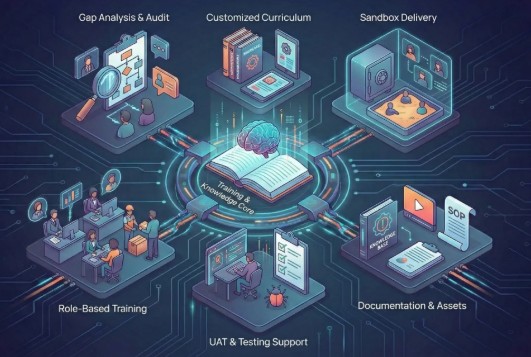
NetSuite is often described as a single platform, but running one well requires something closer to an ecosystem of specialized skills working together. A business might go live with a clean implementation and still find itself struggling six months later, not because the software failed, but because no one thought through who would actually sustain it — who writes the custom scripts, who fields the support tickets, who keeps the integrations running, and who plans for what comes next. Staffing a NetSuite ecosystem well means recognizing that these are genuinely different jobs, even when a small company asks one or two people to wear all the hats.
That recognition is easy to state and harder to act on, especially for companies moving quickly. Finding skilled and experienced NetSuited staffing means looking past a single job title and toward the specific combination of technical development, functional configuration, and ongoing support a business actually needs — because a system that runs finance, inventory, and order management can’t be sustained by generalists alone, no matter how capable they are. Understanding the distinct roles across the NetSuite lifecycle is the first step toward building a team, whether internal, outsourced, or blended, that can actually keep pace with a growing business.
Development: The Technical Backbone
At the development end of the spectrum sits SuiteScript work — the custom code that extends NetSuite beyond its out-of-the-box capabilities. This covers everything from custom validation logic and specialized calculations to client scripts that change how a form behaves in real time. Strong SuiteScript developers combine solid JavaScript fundamentals with a working knowledge of NetSuite’s record structure and governance limits, since scripts that ignore governance constraints can slow down or even break the system under load.
Closely related is SuiteFlow development, which handles process automation through NetSuite’s visual workflow tool rather than raw code. Approval routing, automated status updates, and conditional notifications typically live here. Some developers are strong in both SuiteScript and SuiteFlow; others specialize in one or the other. Larger NetSuite environments often need both skill sets represented on the team, since forcing complex automation into the wrong tool tends to create maintenance headaches down the line.
Integration: Connecting the Pieces
Very few businesses run NetSuite in isolation. E-commerce platforms, CRMs, warehouse management systems, and payment processors typically all need to exchange data with it, and integration work requires its own specialized skill set: familiarity with NetSuite’s SuiteTalk and REST APIs, middleware tools, and the data mapping logic that keeps records consistent across systems. Integration issues are notoriously easy to overlook during testing and expensive to untangle once they surface as real data discrepancies in production, which makes this one of the areas where cutting corners on staffing tends to backfire hardest.
Administration: The Daily Engine Room
Where development handles the exceptions, administration handles everything else — user provisioning and permissions, saved searches, minor workflow adjustments, dashboard configuration, and the routine questions that come up constantly in any active NetSuite environment. A capable administrator prevents the exceptions from piling up in the first place by catching small issues before they become large ones. This role benefits enormously from continuity; an administrator who has been with the system for years develops an intuitive sense of how it’s configured that’s difficult to hand off quickly.
Support: Keeping the System Reliable
Support staffing is often the most underestimated piece of the ecosystem because its value is easiest to take for granted when things are running smoothly. Someone needs to triage issues as they come in, distinguish an urgent problem from a minor annoyance, and either resolve it directly or route it to the right specialist. Without dedicated support capacity, small issues sit unresolved, users develop manual workarounds instead of reporting problems, and confidence in the system erodes even when the underlying platform is functioning fine.
Functional and Strategic Roles
Beyond the purely technical roles, an effective NetSuite ecosystem needs people who understand the business processes the system supports — order management, financial close, inventory control — well enough to translate real-world needs into system requirements. This functional expertise matters just as much during ongoing operation as it did during implementation, since business processes evolve and the system needs to evolve with them. Without this perspective, technical teams can end up building exactly what was asked for while missing what the business actually needed.
Bringing the Ecosystem Together
Few organizations have the volume of work to justify dedicated, full-time specialists in every one of these areas, and that’s where thoughtful staffing strategy matters most. Smaller businesses often combine a generalist administrator with an outsourced partner who can supply deeper development, integration, and support expertise as needed. Larger organizations with heavier NetSuite usage may build out more of these roles internally, supplementing with outside specialists for complex projects or overflow capacity.
What matters most is recognizing that a NetSuite ecosystem has distinct layers, each with its own demands, rather than assuming any single hire or vendor can cover all of them equally well. Businesses that map their actual needs against this full range of roles — development, integration, administration, support, and functional expertise — tend to build teams that can sustain the system reliably as the company grows, rather than discovering gaps only after something breaks. Getting this staffing picture right isn’t a one-time decision made at implementation; it’s an ongoing responsibility that pays dividends in system reliability, faster issue resolution, and a platform that keeps pace with the business rather than holding it back.

