

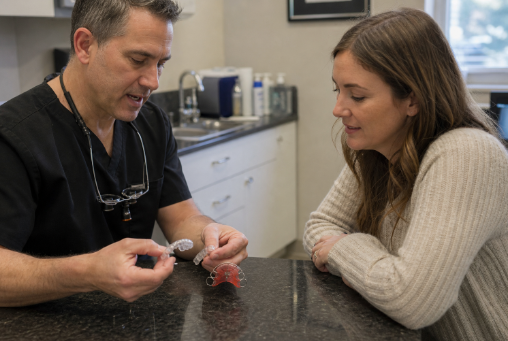
Choosing between clear retainers and Hawley retainers is not simply a question of what looks best at the delivery appointment. For an orthodontic practice, the more useful question is which appliance is most likely to protect each patient’s result, fit the clinical objective, and create manageable replacement needs over the next decade. Both designs can be appropriate removable retention appliances. Clear retainers, often called vacuum-formed retainers, cover the clinical crowns of the teeth with transparent thermoplastic material. Hawley retainers use an acrylic base and stainless-steel wire components. The best prescription depends on the patient’s occlusion, likelihood of consistent wear, esthetic priorities, anticipated adjustment needs, and the practice’s approach to long-term retention.
Start With the Clinical Objective, Not the Appliance Preference
Retention planning should begin before debonding. Review the movements completed, residual growth considerations, periodontal status, restorative plans, parafunctional habits, and whether the patient needs a removable appliance alone or a combined fixed-and-removable strategy. A retainer must support the result the practice seeks to preserve, not merely serve as a standard end-of-treatment item.
Where Clear Retainers Often Fit Well
Clear retainers can be a practical option when a patient strongly values a discreet appliance and is likely to follow the prescribed wear schedule. Because the appliance closely covers the teeth, it can be useful when the clinical goal is to maintain detailed alignment. A randomized clinical trial comparing modified vacuum-formed and Hawley retainers found similar retention of transverse expansion over 24 months, while patients rated the clear option as more esthetic. Practices that want help aligning appliance options with a broader retention workflow can evaluate resources from OrthoDenco alongside their own laboratory, follow-up, and replacement protocols.
Where Hawley Retainers May Be the Better Prescription
Hawley retainers can be especially valuable when adjustability is part of the clinical plan. A trained orthodontic team may be able to adjust wire components or acrylic rather than immediately remaking the appliance after certain minor fit or occlusal changes. That does not mean every damaged Hawley should be adjusted, or that adjustment is appropriate without an examination. It means the design offers a different service pathway than a cracked or distorted clear shell. Hawley designs may also suit cases in which settling of the posterior occlusion is a priority, provided the appliance design and wear instructions support that goal. Their visibility can be a drawback for some patients, however, and the patient must accept the appliance well enough to wear it consistently.
Durability: Think in Terms of Failure Modes
Durability does not mean that one retainer type will always outlast the other. It means understanding how each type tends to fail and how easily the practice can respond. Clear retainers can crack, wear through, heat-distort, or become unusable after being crushed in a backpack, pocket, or vehicle. The American Association of Orthodontists notes that clear plastic retainers can warp when heated or subjected to force, while Hawley retainers can bend or break under excessive stress. Hawley retainers may remain serviceable when properly cared for, but acrylic can fracture, and wires can bend. A distorted labial bow or clasp can change retention and should be evaluated rather than casually bent by a patient or parent. A published survival analysis of orthodontic retainers reported longer median survival for Hawley retainers than for vacuum-formed retainers in the studied patient population. However, individual outcomes still depend heavily on wear, storage, bruxism, diet-related handling, and loss. For prescribing purposes, clear retainers often create a replace-rather-than-repair workflow. Hawleys can create more opportunities for repair or adjustment, but those visits still consume clinical time and do not eliminate the possibility of a full remake. Practices should avoid promising a specific lifespan for either design.
Adjustability: A Meaningful Operational Difference
Adjustability is one of the clearest distinctions between these appliances. A Hawley can sometimes be modified to improve retention, relieve an area of irritation, accommodate minor eruption changes, or address a limited fit issue. The exact adjustment depends on the appliance design, the patient’s occlusion, and the reason for the change. It should always be performed by qualified clinical personnel. Clear retainers are comparatively limited once fabricated. If they no longer seat fully, crack, warp, or fit incorrectly after tooth movement, a new scan or impression and a remake may be the most predictable solution. This can be efficient in a digital practice with rapid in-house production, but it can also create a repeat workflow if a patient has frequent losses or damage.
Cost Over a 10-Year Horizon: Measure Total Retention Cost
The initial appliance price alone can produce the wrong prescribing decision. Clear retainers may have a lower initial fabrication burden in many workflows, particularly when digital models and in-house thermoforming are available. Hawley retainers generally involve different materials and laboratory steps, which may raise the initial cost. Those starting costs are only one part of a 10-year retention plan.
A practical internal cost model should include the following:
- Initial records, design, fabrication, delivery, and patient education.
- Expected replacement frequency for each patient category.
- Laboratory fees, material costs, scanner time, and staff time.
- Repair and adjustment appointments for Hawley appliances.
- Emergency appointments for lost, broken, painful, or poorly fitting retainers.
- The potential expense and patient dissatisfaction associated with relapse or retreatment.
Use practice data whenever possible. Track reasons for remakes by appliance type, age group, treatment type, and time since debond. A practice may find that a lower-cost clear retainer becomes more expensive for patients who repeatedly lose or damage appliances. Another practice with efficient digital production may find that clear-retainer remakes are predictable and profitable. The answer should come from documented outcomes, not assumptions.
Build a Prescription System That Patients Can Follow
Whichever appliance is selected, the practice should provide clear instructions on wear, cleaning, storage, fit checks, and what to do in the event of loss or damage. Patients should be told not to force a retainer that no longer seats properly and not to use hot water or attempt home repairs. Clear expectations about replacement fees, turnaround time, and available backup retainers reduce confusion when problems occur. For many practices, the most effective approach is not Hawley versus clear in every case. It is a documented decision framework that identifies when visibility, adjustability, occlusal goals, patient habits, and replacement risk favor one option over the other. Over 10 years, the strongest retention strategy is the one that patients will wear, the team can monitor, and the practice can maintain consistently.
Conclusion
Choosing between clear and Hawley retainers should be based on the patient’s clinical needs, expected wear habits, esthetic preferences, and the practice’s ability to manage repairs and replacements over time. Clear retainers may suit patients who prioritize a discreet appliance and predictable coverage, while Hawley retainers can provide adjustment options in selected cases. Neither design eliminates the need for proper care, follow-up, and replacement planning. Practices should also look beyond the initial fabrication cost by considering laboratory expenses, staff and chair time, remakes, repairs, emergency visits, and the potential consequences of relapse. Clear instructions on wear, cleaning, storage, and replacement can support better long-term retention regardless of appliance type. Reviewing practice-specific data on failures, remakes, and patient compliance can help orthodontic teams develop a consistent retention protocol that balances clinical objectives, patient needs, and long-term operational costs.

