

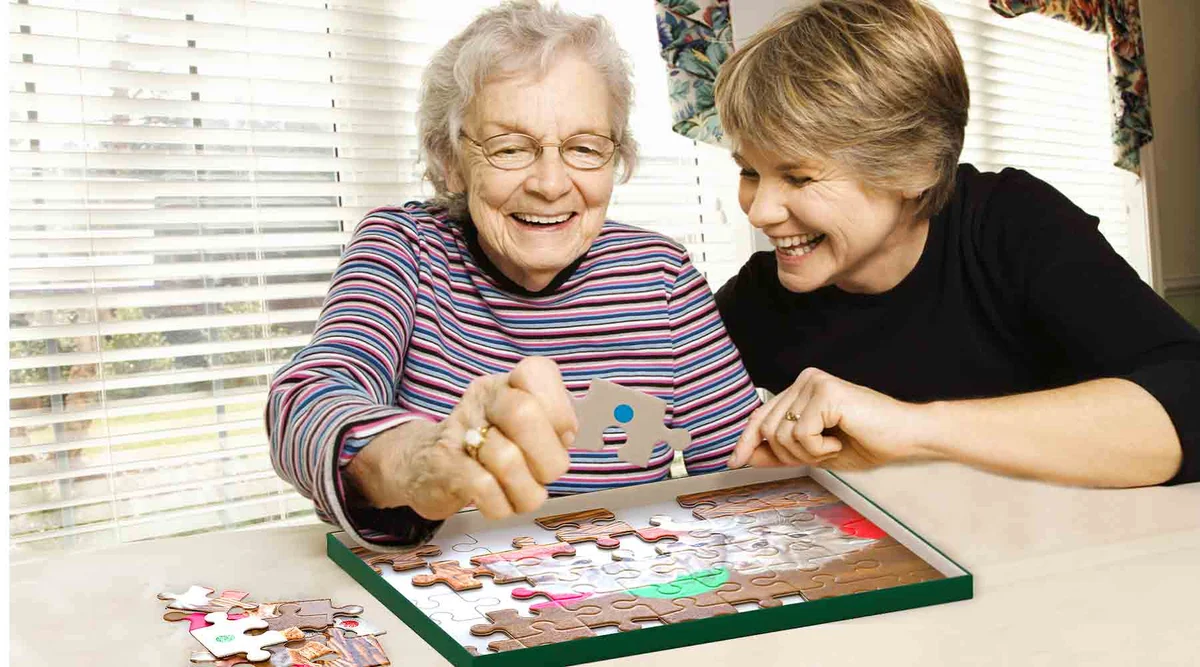
Giving a jigsaw to an older parent often goes wrong on the choice, not the activity. How to pick piece count, images, and format so the hobby actually takes.
Giving a jigsaw puzzle to an older parent or grandparent seems like a safe, thoughtful idea — until you watch it go wrong. The pieces are too small to handle comfortably, the picture is too busy to make out, the 1,000-piece box sits untouched because it looks like work rather than fun. The hobby is genuinely well suited to older players; the mismatch is almost always in the choice, not the activity. Here’s how to get it right.
Match the piece count to enjoyment, not challenge
The most common mistake is picking a puzzle that’s too hard in the name of “keeping the mind active.” A puzzle that feels like a chore gets abandoned, and an abandoned puzzle does nobody any good. The goal is a comfortable, satisfying experience — one where progress is visible and the finish feels achievable.
Start easy. A smaller grid that can be completed in one relaxed sitting builds the sense of accomplishment that makes someone want to come back. You can always increase the difficulty later; you can’t un-discourage someone who found the first attempt overwhelming.
Favour clear images and large, visible pieces
Two practical factors decide whether a puzzle is pleasant or frustrating for an older player: how easy the pieces are to see, and how easy the image is to read. High-contrast pictures with distinct regions — a landscape, an animal, a bold pattern — are far kinder than a dense, uniform image where every piece looks the same. And larger pieces are simply easier on the eyes and the hands.
Consider the digital route
This is where a screen version quietly solves the hardest problems. On a tablet or laptop, pieces are large and clear, images are sharp, and — crucially — nothing can be dropped, lost, or knocked off the table. You can also adjust the difficulty instantly instead of buying a whole new box.
For an easy, no-fuss starting point, a free browser collection like Easy Jigsaw Puzzles covers most of the bases on its own: easy piece counts, clear images, no download, and no account to set up. It’s about the lowest-friction way to try the hobby, and if physical puzzles later prove appealing, it’s a gentle way to build up to them.
Set it up for success
A few small touches make a real difference to whether the hobby actually takes:
- Good lighting and a comfortable, stable surface — a table at the right height, not a lap.
- Start with one easy win before offering anything harder.
- Skip anything with ads or logins, which confuse and discourage less tech-comfortable players.
- Leave it accessible, so it’s easy to pick up for a few minutes rather than a whole event.
The point isn’t the puzzle — it’s the experience
A jigsaw is only as good a gift as it is a good fit. Choose one that’s comfortable to see, satisfying to finish, and easy to start, and you’ve given someone a calm, rewarding way to pass the time. Choose badly and you’ve given them a box that quietly makes them feel worse. The activity was never the problem — so it’s worth a few minutes to pick the version that actually suits the person you’re giving it to.

