

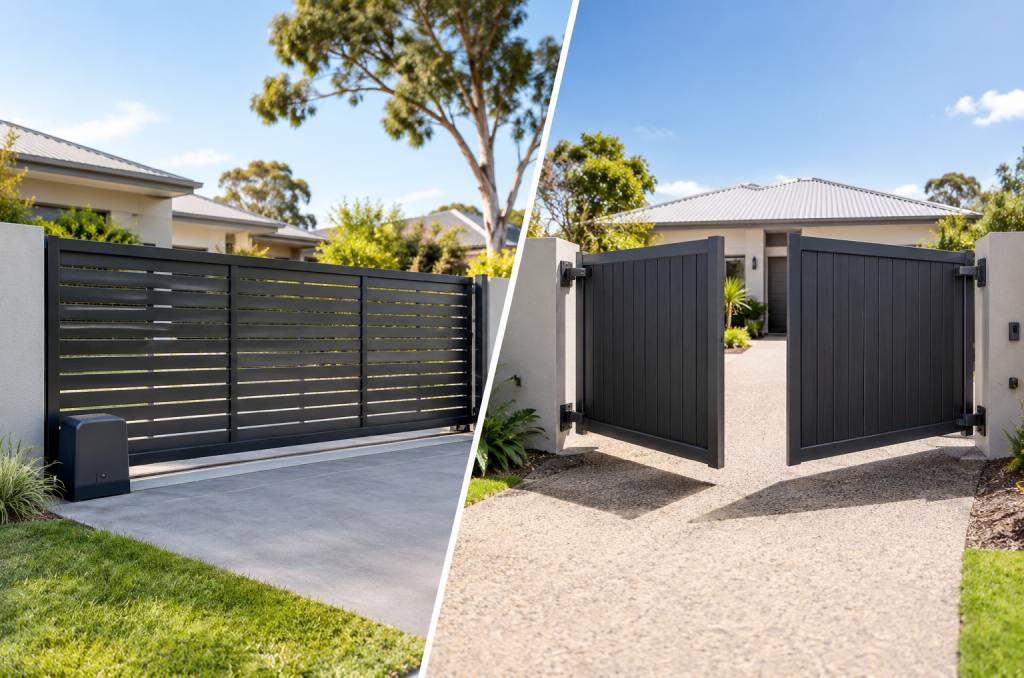
Many Australians choose a gate style based on looks rather than layout. The gate arrives, installation begins, and it becomes clear that the swing arc clips the letterbox or blocks a parked car inside the driveway.
Sliding gates move sideways along a fence line. Swing gates open in an arc on hinges. The right choice depends on your property’s available space, ground slope, and daily clearance.
Choosing the right automatic sliding gate opener starts with understanding which gate type your driveway can actually fit.
How Sliding and Swing Gates Work
Sliding gates travel sideways along a track or cantilever system beside the fence. Swing gates rotate on hinges set into a post or pillar. Each type needs a motor designed for its specific movement.
A sliding gate retracts along the fence line when it opens. It needs a clear run-back path to one side. A tracked system uses ground rollers and a floor rail.
A cantilever system clears the ground entirely and is well-suited to uneven or debris-prone surfaces. It also works well in areas where a ground rail would collect dirt or gravel over time.
A swing gate rotates on a hinge using a single leaf or two leaves that meet at the centre. Sliding gate motors use a rack-and-pinion drive.
Swing gate motors use a linear actuator or articulated arm. Using the wrong motor type causes mechanical failure.
Space, Driveway Layout, and Ground Slope
A sliding gate needs run-back clearance along the fence line equal to the gate’s opening width. A swing gate needs a clear arc in front of or behind the entrance at all times.
Space is the first practical check. A six-metre gate opening needs six metres of clear fence line to one side. Properties with a wall or a neighbour’s fence close to the entrance may not have enough run-back.
A swing gate needs its arc to stay clear at all times. Vehicles parked close to the entrance block an inward-opening gate. An outward-opening gate can swing onto a public footpath, which most Australian councils do not allow.
Slope affects each design differently. A sliding gate can often handle ground that drops to one side. A swing gate generally needs consistent ground clearance along the full arc so the gate leaf does not drag.
On a short driveway where vehicles park near the entrance, a sliding gate is better suited to the space because it requires no clearance in front of the opening.
Cost, Maintenance, Security, and Appearance
Installation costs depend on site preparation, gate size, and hardware quality. Here are the key differences:
- Space and movement: Sliding gates move along the fence and need side clearance. Swing gates open in an arc and require a clear path.
- Slope: Sliding gates can suit some sloping driveways, while swing gates need adequate ground clearance throughout their arc.
- Installation costs: Sliding gates may require extra groundwork for tracks or cantilever systems. Swing gates can cost less on flat sites with suitable fence posts.
- Maintenance: Sliding gates require regular cleaning of the track and rollers. Swing gates require hinge and motor-arm checks.
- Security: Both can provide strong security with suitable locks, solid construction, access controls, and safety sensors.
- Appearance: Sliding gates often suit modern and rural properties, while swing gates complement traditional and heritage-style homes.
Choosing the Right Automatic Gate Opener
Sliding and swing gates require different motors. The opener must match the gate’s movement, weight, travel distance, and daily usage.
- Motor type: Sliding gate motors use a rack-and-pinion mechanism, while swing gate motors operate through a lever arm.
- Motor capacity: Choose a motor rated for your gate’s weight, width, and frequency of use. High-traffic entrances may need a more powerful system.
- Power supply: Solar-powered openers suit remote or off-grid properties, while mains-powered models work well where reliable grid access is available.
Once a sliding gate suits your driveway, choose an automatic sliding gate opener that matches its weight, travel requirements, and daily use.
Make the Decision Based on Your Property
The right gate fits the driveway, not the other way around. Side clearance and swing clearance are the two checks that narrow the choice.
Measure available side clearance before choosing a sliding gate. Measure the full swing arc before choosing a swing gate. Check the slope along the travel path and confirm the ground suits the installation type.
Consider daily access patterns. A property where vehicles park close to the entrance needs a gate that does not swing inward into the parking area.
Match the motor to the gate’s weight, width, and daily cycle count. Both gate types perform reliably over the long term when the gate, site conditions, and motor work together.
Always check local council requirements before automating a gate, particularly if the gate opens toward a public footpath or road boundary.

