

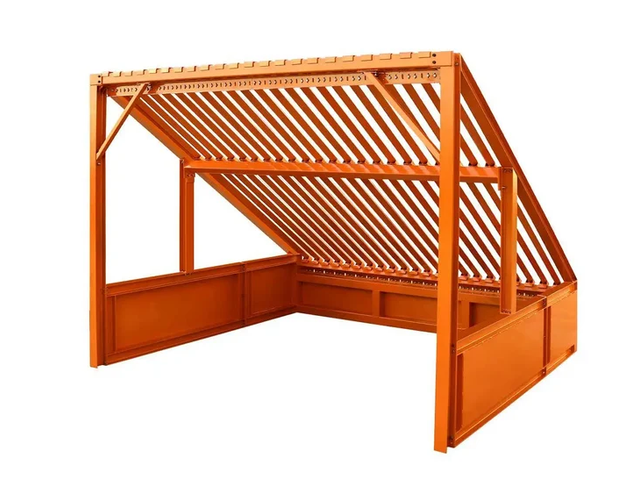
Screens get compared by the size of the deck, which reads like capacity and is not. Material only separates while it is in contact with the mesh and moving across it, so the figure that governs throughput is how long each shovelful stays on the surface. A heavy duty grizzly rock screen is tuned through its angle long before anything is done to its size.
What separation actually requires
On a topsoil screener a particle smaller than the aperture still has to arrive at an opening, present itself at an angle that fits, and fall through. None of that is instant, and all of it needs the material to be tumbling rather than sliding as a mat. A steep deck sheds material quickly. Everything reaches the bottom, very little has time to drop through, and the oversize pile ends up full of fines that should have been separated.
Angle is a trade, not a setting to optimize
Shallow angles hold material longer and separate more completely. They also slow the whole operation and risk the deck loading up faster than it clears, at which point the surface is buried and nothing is screening at all.
The workable range on most static screens is narrow, and the right answer changes with the material. Dry sandy loam moves freely and wants a shallow deck. Heavy clay needs a steeper one simply to keep moving.
Wet material blinds a screen from underneath
Blinding is when the apertures fill and stop passing anything, and it almost always starts on the underside of the mesh, where damp fines pack into the openings and are not visible from the working side.
Nothing about the feed rate fixes this on a topsoil screener. The screen has to be cleared, and the real answer is to wait for the material to dry, because a screen that is blinding will blind again within minutes of being cleaned.
Feeding is where most of the capacity is lost
An operator with a loader tends to place a full bucket onto the deck in one movement, because that is the fastest way to empty the bucket. It builds a pile, and material in the middle of a pile never touches the mesh at all, so most of that load leaves as oversize.
Three habits recover more throughput than any adjustment:
- Spread the bucket across the deck width
- Feed at the top, never into the middle
- Let the deck clear before the next load
The third is the one that gets rushed when a truck is waiting. A deck already carrying material cannot accept more without burying what is on it, so the operator ends up moving the same soil twice and the topsoil screener spends half its time holding material rather than separating it.
An adjustable deck is a settings range, not an upgrade
Adjustability exists because no single angle suits topsoil, crushed rock and demolition fill. Being able to change it between jobs is worth more than any particular fixed angle would be. In practice most operators find two positions and use them. A shallow setting for finished topsoil where cleanliness matters, and a steeper one for bulk rock separation where speed matters and a few fines in the oversize pile are acceptable.
Aperture size decides the product, not the speed
A grizzly with wide bars is a rock separator. The same frame with finer mesh, or a trommel screen alongside it, does a different job, and the two jobs have very different throughputs even though the structure has not changed.
Deciding the product first is the step that saves money. Screening to a finer grade than the end use requires costs time on every load, and once the specification is set, the aperture follows from it rather than the other way around.
Frame, feet and what twelve feet means in practice
A twelve by nine foot deck needs ground that is level enough for the frame to sit without racking, and room for a loader to work at the high side and a truck or pile at the low side. That is a larger footprint than the screen dimensions suggest.
Setting it near where the screened material will be used saves more handling than anything else on this list. Material moved twice costs twice, and a screen placed for convenience during delivery rather than during use creates exactly that.
Reading a specification honestly
Deck dimensions, aperture and frame weight describe the machine. Angle adjustment range, how the deck is cleared and whether the mesh can be changed describe what it will do across a season of mixed material.
TMG Industrial builds this one as a twelve foot deck with an adjustable angle. Matching the aperture to the end product, and then the angle to the moisture on the day, is what turns deck area into actual throughput.

