

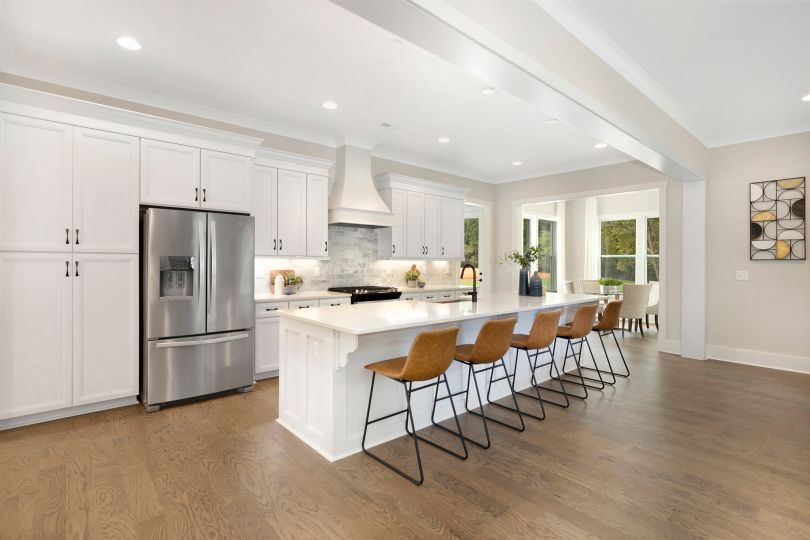
The majority of our Wish Lists are delivered to us in the form of a Room List, Saved Images Folder and Square Footage Target. This initial communication with the owners is the first step in developing a good brief or Wish List for the future house. The Wish List can help prevent Change Orders, shorten Selection Meetings and provide a defensible basis for the decisions of the design and construction team 6 months down the road.
Start with how the household operates, not with rooms
Typically a list of rooms for a home contains a number of underlying assumptions about how a family will live in their new home. Documenting the current daily activities of the family as well as the seasonal activities will help expose many of these assumptions and ultimately help develop a home’s plan to meet the family’s needs.
Turning habits into requirements
Your owner’s wish list for their future home needs to include more than just the rooms that they want in their home. Rather, the owner’s wish list for their future home needs to list out the conditions of the owners’ future home. For example, rather than listing out a mudroom for the owner’s future home, the owner should list out that four people and two dogs enter from the garage at the same time on wet afternoons and need somewhere to shed their gear out of sight of the kitchen in their future home. Other rooms and conditions need to be included in the owner’s wish list for their future home.
- Entry and exit patterns, including who arrives from where and carrying what
- Noise tolerance between zones, especially sleeping, working, and media areas
- Hosting frequency and realistic guest counts, separated from aspirational ones
- Aging plans, including whether a main floor suite is a requirement or an option
- Storage volumes measured in linear feet of hanging space and shelving, not adjectives
Write requirements as performance, not product names
Windows, Selection of windows early in the design process can result in a “fixed price” for the windows; however, the fixed price does not guarantee the desired performance. Thus, it is important to define the performance requirements for the windows (e.g. West facing glazing, Heat gain control, View preservation). The design team can then use a variety of solutions to achieve the performance requirements for the windows (e.g. Orientation, Overhangs, Glass coatings, etc.) at a cost less than the owner’s original estimate for the desired performance.
Where brand names still belong
Instead of detailing the performance of a specific hard object, list the choices available for owners to select from in their wish list. This influences the allowance and typically is the object with the longest lead time.
Attach money to the list before the first floor plan
You can use your wish list without having to cost weight each of the items, but then you will have to discuss the cost of each item with the contractors when they provide you with an estimate for the construction of your house. Assign a priority band to each of the items on your wish list, and then try to assign a rough share of the construction budget to each of the items. This way you can agree in advance which of the higher priced items in the higher priced priority bands you will have to cut back on to keep your wish list within the contractors’ estimated price for the construction of your house.
| Decision category | Point at which it must be locked | Cost of changing it later |
| Footprint, massing, and roof structure | Before permit drawings are sealed | Severe, triggers redesign and re-review |
| Mechanical, plumbing, and electrical layout | Before rough-in inspection | High, requires demolition of finished framing |
| Windows, doors, and exterior cladding | At or before framing start | High, driven by lead times and restocking terms |
| Cabinetry and tile layouts | Before drywall | Moderate, mainly schedule impact |
| Paint colors, light fixtures, and hardware | During finish phase | Low, absorbed with minimal disruption |
Include the parts of the house nobody photographs
Items related to construction quality are not typically included in an owner’s wish list because they are not visible in the finished photos. However, these items impact how a house functions for the next 30 years. Owners who list these items are treated differently by bidders in terms of scope and pricing. These items are estimated and the scope becomes comparable.
Items worth stating outright
- Air sealing and blower door target, with a stated number rather than a promise of tightness
- Insulation approach at rim joists, attic penetrations, and any conditioned crawl space
- Water management details, including flashing at windows and drainage away from the foundation
- Duct location, with a preference for conditioned space stated in writing
- Third party inspection or testing, and who pays for it
Use the list to evaluate builders, not just to instruct them
Take your wish list and go hand it out to the people on your short list for the construction of your custom home and associated grounds, and if you are building in that region it is worth adding a proven builder of custom homes Charlotte NC to that list. See what kind of questions they give you and compare the answers of the shortlisted candidates. The builder who lists off the soil conditions, the utility lines, the lead time for completion etc. Is estimating. The guy who can give you a price per square foot in less than a day is guessing.
What regional knowledge adds
When interviewing candidates for the best custom home builders for your new house, ask each of them to mark the three items on your wish list that will most likely change during the construction of your custom home. Then ask each of them to explain why they chose the items they did. A local custom home builder, such as a custom home builder in Charlotte NC that custom homes Charlotte NC owners commission, will know the review timelines for various systems of construction will be long, and how clay soils in particular impact the budget for the foundation and the grading for your new house. Each trade has its own unique way of dealing with its commitments during the busy construction season.

